The Magic Begins Taking the Detour
A Road Trip Story with Heart, Humor, & Hope! ---- Feels like a conversation with an old friend! If you are looking for a soul-warming escape, this is it. Perfect read in advance of America’s 250th birthday.
HEARTLAND HIGHWAYS: In Search of America by John W. Butler is available from Amazon and Barnes & Noble.
WINNER of the 2025 American Writing Awards for non-fiction, travel story!
Book of the Year 2025 Awards Finalist for the Independent Author's Network in two categories: “Non-Fiction: Adventure” and “Travel!”
John W. Butler is an award-winning author and broadcaster—a storytelling road warrior with a country soul and a sharp wit, equal parts Texas radio charm and Maine forest mystery. "Heartland Highways has all the ingredients of a classic road narrative: humor, grit, cultural soul.” - C.S. (Reviewer)
Perfect for readers of Blue Highways, Eat Pray Love, and Travels with Charley—a journey through America’s heart that feels like coming home. The perfect read for America's 250th birthday, because what better way to celebrate than with a genuine, entertaining, soul-searching road trip through the whole dang country?
BUGS, COFFEE TALK & GALLBLADDERS
Maybe, it the revenge of the bugs? I wouldn’t put it past them. What if one of them lived long enough to pull off a stunt like in one of those suspense thrillers where you think the bad guy is dead, but he’s not.
So, I spend the next twenty-minutes with my tools reattaching the hose and fastening the clamp. No easy feat ….

Continuing my road trip north on Highway 83 — America’s Heartland Highway, from Texas to North Dakota.
Mile after mile of mostly flat to gently rolling farmland. Acres of corn, soybean, wheat and sunflowers.
And bugs.
As I drive between the endless fields on this less traveled two-laner sitting on my soft leather bucket seat, gently gripping the ergonomically shaped steering wheel, there is a constant splatting sound on my front windshield. Thousands-upon-thousands of bugs, from flies to grasshoppers are ending their short little lives on ARGO’s front bumper, grill and windshield. So many that it obscures my vision of the road ahead.
I’ve used up the window washer fluid attempting to reduce the bug-buildup. A yellow warning message is now flashing on the instrument panel in-between the speedometer and tachometer, letting me know the washer fluid tank is near empty.
Ahead is a “town,” which consists of a single gas station. Like many stations in rural areas, it also includes a tiny version of a grocery, hardware, entertainment-center and auto supply store. This one even has a soft-serve ice-cream machine. And guess what, they have cases of window washer fluid stacked up on the right side of the door. Only a dollar for a gallon. Perfect.
As ARGO’s tank is being topped off with diesel, I scrub the windows clean with the station’s long-handle squeegee. Then I pull the black hood release lever under the dash, pop the safety catch under the hood, raise it to locking position, and happily fill the plastic washer fluid tank with the gallon of dollar cleaner.
If this were a movie, it’s the kind of moment when I would be whistling a tune watching the fluid fill the tank. Except, I can’t whistle worth a darn.
Anyway, feeling so good about the whole thing, I close the hood and go back inside the station to buy an ice-cream cone to celebrate my accomplishment. A roady cone.
All is good … till I walk back outside. Underneath ARGO’s engine something is dripping in a steady flow onto the concrete drive, forming a pool of liquid. Oil? Diesel? I touch the liquid with my index finger; smell it. Dang, it’s the vinegar smell of washer fluid.
As I hold the cone in my left hand while licking the cold sweet vanilla cream, I raise the hood with my right hand enough to see the plastic washer fluid tank I just filled is nearly empty; depleting rapidly as I watch. Poking around underneath I discover a hose clamp came loose … apparently when I filled the tank to capacity with the gallon of dollar-cleaner. It’s now, a dollar on the ground.
Maybe, revenge of the bugs? One of them lived long enough to pull this stunt. I wouldn’t put it past ‘em. Like in one of those suspense thrillers where you think the bad guy is dead, but he’s not.
So, I spend the next twenty-minutes with my tools reattaching the hose and fastening the clamp. No easy feat due to the location of the hose under the tank, with only a small space where I can reach my hands down to do the work by feel. Finally, success. The hose is attached good enough for now.
I go back in the store, buy another gallon of window washer fluid for a dollar, fill up the tank and shut the hood. Nothing is leaking as I study the underside.
Now I am back in the captain’s chair, with a clean window in front of me, on the road again in a perkier ARGO, brimming with diesel and washer fluid … and me filled with a hastily eaten vanilla ice-cream cone.
I drive to the next small town in Nebraska. Forgive me, but I’m leaving the name of the town out at this point, since I’m going to share some gossip about a few of the locals; a guy named, Walter. And Walter’s wife.
Like nearly all small towns, there are too many empty store front plate-glass-windows, behind which, once were enterprising retail stores run by moms and pops. The backbone of the community. That back was broken by the big box stores, the internet and younger folks moving away.
This town seems to have a bit more life than most. I’m just basing that on the fact a few people were walking on the sidewalk along main street. They were talking to each other. More activity than the other rural towns I’ve passed through.
One store front catches my eye; a bakery. It’s mid-morning and I haven’t had breakfast yet. Driving in front, the sign says they’ve added a coffee shop. Bakery plus coffee works for me.
I park ARGO on the next side street. Walking up to the front door with my schnozzola on alert.
Let me pause here, and apologize, I just like to say schnozzola, a.k.a. “proboscis.” Reminds me of the old comedian, Jimmy Durante, a TV favorite of my grandmother. I have fond memories of my grandmother and me laughing at his jokes together. Who doesn’t like a funny guy with a big schnozzola.
So … my schnozzola leads me through the front door of the bakery, filled with the aromas of dark coffee brewing, combined with another come-hither-whiff: apples and cinnamon in the latter stages of baking.
Inside the bakery, I feel a bit of disappointment as I look through the glass of the wood framed display case. There is little remaining in the way of baked items. Most of whatever was on the shelves is gone. Little spots remain indicating the shelves had probably been filled earlier that morning with real goodies. A danish-type thing with cinnamon remains, so I point to it.
The sign on the back wall lists a selection of coffees, patterned after you-know-who. The conglomerate with the round green logo on every other street corner in bigger cities providing a supply-line to poor pathetic caffeine addicts, like me.
I look over the listings of macchiato, espresso, cappuccino, mocha-blend and such. Standing there waiting for the lady in front of me to order, I’m thinking how, not that long ago, you only asked if the coffee was fresh or not. You were happy if had been made in the last few hours and was reasonable warm. And, of course, it was only a fraction of the cost.
“I’ll have a latte with a half-shot of caramel,” I say.
The shop is small, but there’s a wide opening cut in the left side wall, opposite the counter, opening into a dinning room in the adjoining building. Tables, chairs and a few booths are set up for about thirty to forty people. A sign says they have live music on weekends from time to time.
I put my backpack down in one of the rear booths. A quiet space. I’ll be able to write. Maybe read.
A man and woman are at one table on the far side talking.
At a table toward the center, six men are having coffee and jawing. They stopped talking when I walked by, now they are talking again. The acoustics of the room carry the men’s voices my way.
Four of them are slim men with disappearing butts. One is on the heavy side; another one has a beach ball tummy hanging well over his belt buckle. I am assuming, of course, he had a belt buckle.
A new guy walks in, joining the group.
“Where you been?” one of the guys says to the new arrival, “we missed-ya last few days.”
“Had to get my medicines adjusted,” he answers.
“Oh,” says another man who is sporting a camouflage ball cap with the logo of a bridge on it, “you okay now?
“Yep, but had to go to the hospital for a day … just to do it.”
“You go here?” Another asks, “or the new one down the road?”
“Here.”
“Not sure I’d go to the new one,” another guy says, “with what I’ve heard.”
“Yep, think they’re understaffed; still working the bugs outta the new one.”
I’m trying to tune out the exchange. Starting to settle in over my hot latte. Stream rises up as I take in the caramel overtones coming from the thick ceramic cup. Smells woody-sweet.
I like my coffee dark roasted. Like to joke that it “needs to be strong enough to walk across.”
That line gets an understanding smile and a nod from a fancy coffee shop barista. From a truck stop waitress, well, she’ll just look at me expressionless. Either way, I enjoy these tiny human interactions prior to receiving my morning java fix.
The door opens in the middle of the store-front of the dinning room. A group of six ladies walk-in off the sidewalk. They appear to be in their fifties and sixties, wearing muted casual dresses with matching hairdos.
All seem to be talking at the same time, over each other, as they make their way past the table of men, continue towards me, look around, then select a table near my booth.
No more silence.
I attempt to focus on my coffee. Still a bit of steam rising. I take a small sip. That’s always an “ahhhh-moment” for me; the first taste of freshly brewed coffee. Especially in the morning.
The ladies are chatting away. I don’t normally listen to other people’s conversations, but this one I can’t avoid. They’re talking loudly.
“I wish I could have seen my gallbladder after they took it out,: one of them says.
“You’d want to see it?” A puzzled friend questions in surprise.
“They said it’s full of stones. I’d love to see what that looks like.”
“What I wonder is,” another said, “after they take out your gallbladder how do you digest?”
The question goes unanswered.
Another woman asks, “But what about the new stones? Where do the new stones go? You know if you don’t have your gallbladder anymore….”
That question also goes unanswered. The conversation switches to one of them buying a vacation home in Colorado.
“So Mary, how was your trip to Colorado. You get situated?”
“As you know, we bought a smaller home, like I told you about,” Mary shares. “Really cute, just perfect for Ralph and me. And they told us it would be empty of the other people’s furniture as soon as we closed on it. But when we took our first load, we couldn’t believe it, their furniture was still there.”
“Oh, my God, you got all the way there,” a friend asks, “and the people hadn’t moved out yet?”
“Full house! What were we to do. We didn’t know. Called the Real estate lady, and she didn’t know either. So there we were with our furniture and nowhere to put it. Real estate lady called us back latter, saying they needed another week.”
They continue on about the furniture and how to handle such a calamity.
Now the conversation is back on health issues, and with a twist. Someone named Walter is in the hospital.
“He was all blowed up,” says a lady who visited Walter yesterday at the new hospital. “They had to get the swelling down.”
“Is Walter going to be okay?”
“As long as he gets four hours of sleep, he’s okay.”
A lady who hasn’t spoken yet says, “This is just between us, but I thought you’d want to know….”
They lean in closer to each other. Whispering. I pick up enough to know they are not talking about Walter now, but Walter’s wife. It’s some heavy gossip. In order to protect the innocent I won’t repeat it here.
I’ve observed, that the more important the gossipy news is between friends, the softer the volume of the voice relaying it.
Hushed tones continue as they share stories about Walter’s wife, and poor Walter in the hospital.
Of course, these ladies might as well be shouting into a radio station microphone, printing it in the newspaper, or putting it out on social media. In a town this size it’ll be general public knowledge before noon, passed person-to-person, each time with the warning: “This is just between us, but I thought you’d want to know.”
Gossip, from the mouth of a skilled tittle-tattler, can gut someone they don’t like, clean the meat off their bones, and serve ‘em up stone cold dead before the victim finishes their morning coffee.
Time to move on down the road for me. I leave a tip on the table; sling my backpack over my left shoulder. As I turn opening the door to leave, I see both the group of men and the women stop talking, look at me and watch me walk away.
These morning coffee talk conversations are not peculiar to small towns. They go on every morning all across America. Probably the world. Mostly retired types solving world problems, along with bitching and griping about their phone bill or car repair or whatever wrong they want to be righted.
To them, I’m just another stranger passing through town. Not from around here.
And it’s on down the road I go. Discovering America one story at a time.
JohnButlersBuzz.com
MAKING MILLIONS WITH FREE ICE WATER
The imbecilic graffiti triggers a super odd flashback. Reminds me of arriving on the University of Texas campus in Austin to start classes. It’s the beginning of my university education on the famed forty-acres. I walk into the UT Tower building at the center of campus, making a stop at the restroom located just beyond the north-side doors.
On the metal stall wall is written:
(Also on the BUZZ PODCAST link in the article)

Swelling clouds with rich flame-blue colors, swirled with orange-red, moved south to north overhead.
Of course, by the time I got a camera in hand, the clouds had mostly dissipated. Managed to catch a fleeting shot; nothing like the fullness of it when I first stepped out of ARGO. The scene became a video-short in my mind’s filing cabinet. Odd how these moments occur. - John W. Butler
(9 minutes read time or click on Buzz Podcast to listen to the audio version)
Leaving Pierre, the Capital of South Dakota, I headed west on Highway 14, away from 83, towards the Black Hills. Highway 14 is a long straight two-laner, with one sharp left, and one sharp right between Pierre and Wall. It cuts across South Dakota, east to west, through miles of hay fields and rows of five-foot-tall sunflowers.
These big-brown-faced sunflowers are beautiful with their perky yellow petal fringe; and as farmers discovered, a valuable crop. Sunflower nutrients are used in various foods and to make vegetable oil. The seeds are healthy snacks. They also possess a power to clean the environment, called phytoremediation. Tuck that away for the next time you are playing environmental trivia with your friends!
A less visual person would become bored with the view. Not me. Ever-so-many-miles midst the sunflowers, bluestem, and switchgrass are homemade looking signs of varying shapes. Sign after road-sign advertising a drug store. I started seeing them more than two hours away, some giving the remaining distance: “WALL DRUG JUST X-MILES AHEAD.”
I could care less about a dang drug store ahead. However, the signs broke the pattern of the fields. After the umpteenth one, they got the inquisitive side of me wondering what the heck could be so special about a drug store.
The signs touted, “free ice water.” Another one claimed a cup of coffee could be had for only five cents. Apparently, that was an old sign with a neglected price update. Coffee below five-dollars is getting harder to find these days, much less a five-cent-cup.
I later find out signs have been posted as far away as China and Australia promoting the distance to Wall Drug store. And, no, it has nothing to do with the big “Wall” store that uses “mart” in the latter portion of its name. In case you were about to ask.
It’s sunset when I arrive in Wall, South Dakota at the intersection of I-90 and 240. I pass two gas stations and a Dairy Queen. Two RV’s and a semi are parked between one of the stations and a giant, eighty-foot tall, green dinosaur.
A few blocks down the way, Wall Drug store proudly sits along a narrow main street boulevard. Cars are parked along both sides in front of the drug store and a line of tourist shops, ranging from t-shirts to expensive jewelry. Trucks, buses and RV’s are routed to a graveled lot around the corner.
Wall Drug is the anchor for the tiny town of Wall, South Dakota. A burg that continues to exists because of it, along with it being the main turnoff to the Badlands and at the feet of the Black Hills.
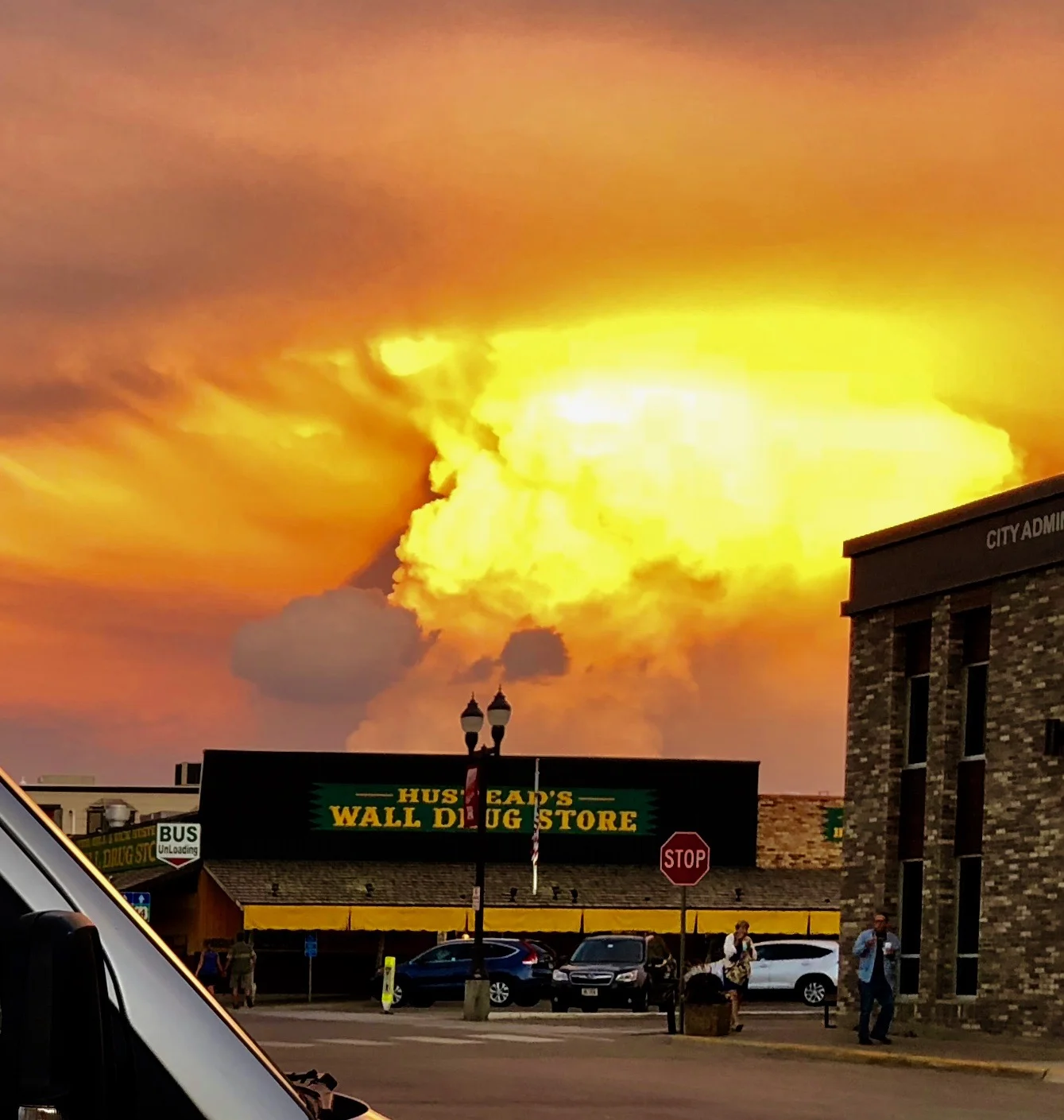
As I step out of ARGO, I’m caught by the artwork in the sky over Wall Drug store and adjoining buildings, I knew I had to capture the moment with my camera. Swelling clouds with rich flame-blue colors, swirled with orange-red, moved south to north overhead.
Of course, by the time I got a camera in hand, the clouds had mostly dissipated. Managed to catch a fleeting shot; nothing like the fullness of it when I first stepped out of ARGO. The scene became a video-short in my mind’s filing cabinet. Odd how these moments occur.
Maybe it’s just because of seeing sign after sign, but the drug store does look interesting enough to explore. Something different after driving the miles. And, there are no other stops for many more miles.
I decide to stay the night, but looking at the motels available, I head toward the green dinosaur, where I saw the two RV’s camping. I figure I can have breakfast in the morning at Wall Drug Cafe inside the store, walk the place, then move on east on I-90 toward Rapid City. Without a lot of internal debate, which I sometimes fail into, I go with this plan.
Next morning at the cafe, I pass the buffet line with the usual suspects. Both the ones standing in-line and the fare served on-the-line.
As I walk around taking in the hodgepodge of artifacts on display, I make a stop in a bathroom across the courtyard, in what’s referred to as the back-shops.
Okay, stay with me here. On the stall door some lad who thought he was witted, maybe a budding standup comic, used a black marking pen to proclaim, “I took a dump at Wall Drug.”
Not really funny, except, after all the road signs I passed, it is kinda amusing.
The imbecilic graffiti triggers a super odd flashback. Reminds me of arriving on the University of Texas campus in Austin to start classes. It’s the beginning of my university education on the famed forty-acres. I walk into the UT Tower building at the center of campus, making a stop at the restroom located just beyond the north-side doors.
On the metal stall wall is written:
God is love.
Love is blind.
Ray Charles is blind.
Ray Charles must be God.
It was my introduction to inductive logic. I hadn’t walked into a classroom yet, and I was already being educated. Right there, on the wall of the men’s room stall in the UT Tower. Some student, or more likely a philosophy professor whose class I would take later, was applying sophisticated logic to solve one of life’s great mysteries.
I thought to myself, this college experience is going to be different. The people here think differently.
Okay, back to Wall Drug. After leaving the bathroom, my attention turns to the numerous black and white photos framed on the walls. I love historical photos capturing moments in time of the people who preceded us. The walls are covered in them. Many images dating back to the 1800’s, when cameras were scarce, and photos were a novelty.
As I start scanning them from the left side of the wall, there is a series of five photos tucked in a corner, half hidden by a wooden carving of Native American chief. The images capture a darker moment in time, the hanging of a man who killed two other men.
George Loveswar was convicted of murdering George Puck and Henry Ostrander. This is his day of reckoning, September 19, 1902.
Loveswar, a white man who appears to be in his twenties, is walking up the steps of a wooden gallows. The typed caption reads, “This was the last legal hanging in Meade County. An ordinary picture of an execution by hanging in not scarce, but a sequence of pictures such as this is rare indeed.”
The next photo shows the sentence and prayer being said over him as he awaits. The noose is placed around his neck. The last picture is after he drops to the end. The photos are haunting.
I move on to lighter subjects. There are rare vintage photos of Native American Indian reservations. Extraordinary scenes of routine activities, like a group of Lakota tribe women washing clothes and entrails in the river. Cowboys branding cattle. Scotty Phillips, an early West River rancher, in a wagon with his sons, being pulled by a team of buffalo. Main Street in nearby Sturgis, filled will cattle, wagons and ranchers. Soldiers lined up near Custer at the Gordon Stockade in 1874. Calamity Jane. Annie Oakley. Buffalo Bill.
I walk back through the courtyard, past the giant fiberglass rabbit, to the cafe. Usually, I try to eat healthy, going with food choices high in protein, low in carbs, with bad fats reduced. But occasionally, too often than I care to admit, Satan calls. He’s a powerful tempter you know. A master at it.
I stand firm against the evil force. But then I am weak, seduced by saturated fats, lured into the black hole of the grease trap of food choices.
I’m not alone. Many have fallen into that pit, based on the number of oval people I see everywhere. I’m not judging, mind you. Just observing, okay. Many, maybe most American’s, are ovals. I was once a skinny kid, but on this trip, I’m gaining a few pounds. I could quickly become an oval too. Easily, ‘cause I love to eat.
The ovalness of John could happen. Just two days ago I passed Zesto’s, a tiny standalone ice cream shop in Pierre, South Dakota. Their slogan is, “Zestos is Bestos.” Get it?
Yes, I gave in. I threw my culinary caution to the cream.
Zetos is an old fashion kinda place where you pull up in your car, walk up to a window and place your order. There is a changing flavor of the day, which happens to be blackberry today. You have a choice of four sizes for an ice cream cones ranging from “Toddler” size (at another place would be large), on to “Adult” (the supersized one), too big for the cone to hold it, so it’s dumped into a cup with cone mounted on top.
Cars were pulling up, with a continuous line of people at the two windows waiting to order. Fearing I would miss the excitement of experiencing Zetos apparent tastiness, I turned ARGO around, finding a spot to park across the street.
With modesty and refrain, I ordered the toddler size. A twist of vanilla and the flavor of the day, blackberry. Didn’t want to over-commit to the unknown blackberry, and figured vanilla would be safe as the fallback. And all on one cone. Yes, overthinking it. I know.
All my hopes were confirmed. The moment my tongue touched the blackberry, a spark of cold happiness shot through my body, right down to my toes. People who enjoy life, especially life with good ice cream on their tongue understand what I’m saying here.
It was good. And I was pleased that I was measured in my selection of size. It was more than enough to satisfy my desires for something sweet. And I now had experienced Zetos.
But that is the way Satan works. A tiny taste on the tongue. A pleasing sensation, not harmful in any immediately apparent way. So yesterday I’m passing by Zetos again, entirely by accident. I think to myself, if the cone was so good, I bet they make a good malt or shake. I’m hungry. Maybe I could substitute that for the usual fare. Something different, eh.
There are three sizes for malts and shakes. I go with small. But, then I think about it. Since I’m substituting this baby for a meal, maybe I should go with a medium. Yep, a medium it is. And make it a malt. A chocolate one.
Not every place makes a malt anymore. I am “killing two or three birds with one stone, so to speak.
When the cute high school girl reopens the window, calls my name, placing the malt on the counter, the “medium” looks supersized to me. The contents are so thick it’s impossible to draw through a straw. I need a spoon. And, yes, it’s fantastic.
I’ll only eat half of it, I say to myself. Of course, as it melts to the point the viscosity allows for sucking the sweet cream up through the straw, I realized about two-thirds of it has been consumed. Consumed by me.
I’m feeling okay … for a while. Then the digestive process starts to say, “Hey, what a minute, what the $#@&*%#?” Alarm bells go off. Angry alarms, signaling an attack of bad trans-fats accompanied by legions of comrades in heavy organized battalions in full-armor carrying heavy artillery. My mind immediately denies the blame. It’s the Russians. Dang Russians.
I managed to live through it, with a pledge to God-Almighty, “I promise I’ll stick to only the good food choices, never backslide like this again.”
But, then today, I’m at Wall Drug Cafe. As I’ve said, they are famous for their free water and five-cent coffee, of course. But they are also renowned for their homemade donuts. Also, their pies. Today it is apple, cherry or blackberry. I resist the donuts. Stand strong. But, the pies are thick, full of fruit, with thin crusts, like my mom made.
A flashback of sitting around the kitchen table with mom and dad, God rest their souls, and my sister, Cathy, having mom’s homemade, from scratch, pie. Nostalgia is overwhelming me.
I know, I know. A bit of sentimentality is a good thing, but it can also be a useful tool of the Devil. And once again, I give into temptation. Cherry pie it is.
And, what the heck, maybe a donut for the road.
Hey, they are “world famous,” don’t-cha-know. Most likely, I’m only traveling this way once. I would regret missing out, denied from the joy of it all. I take a bite of the donut before I get out of the store, and instantly justify; something this good can’t be a devilish seduction, has to be from above, a Heavenly reward. It was like being kissed by an angel.
So, what made a tiny drug store along this long stretch of highway, “world famous?” Well, it all started with the advertising slogan: FREE ICE WATER.”
The family who thought up the marketing scheme, Dorthy and Ted Hustead along with their son, Billy, were marketing geniuses with a simple come-on, free ice water.
You’re saying, “No way.” I’m telling you that’s how it started. Offering free ice water, followed by a five-cent cup of coffee. That opened the door to visitors spending real money on the cherry pie, donuts and then an up-sale to the souvenirs. Smart thinking, and lots of signs.
As I look around, the store is filled with customers, all buzzing-high on cheap coffee, donuts, and pie, spending money like drunken sailors on souvenirs and knick-knacks.
The Hustead family grew the drug store they bought in depression era 1931, into a renowned retail roadside legend. This family kept a small town alive and thriving. In the process of building a legendary business, they became wealthy, and also, generous philanthropist helping many causes. The American Dream exemplified.
And so it goes. And so I go, on down the road, albeit, loaded with a few thousand additional calories and one-toke-over-the-line of nickel-a-cup-coffee.
~~~~~~~
Thanks for coming along on the journey. Sign up for email alerts at JohnButlersBuzz.com — Discovering America One Story At A Time.

Rare vintage photos of South Dakota life. - John W. Butler

IS MOUNT RUSHMORE REAL?
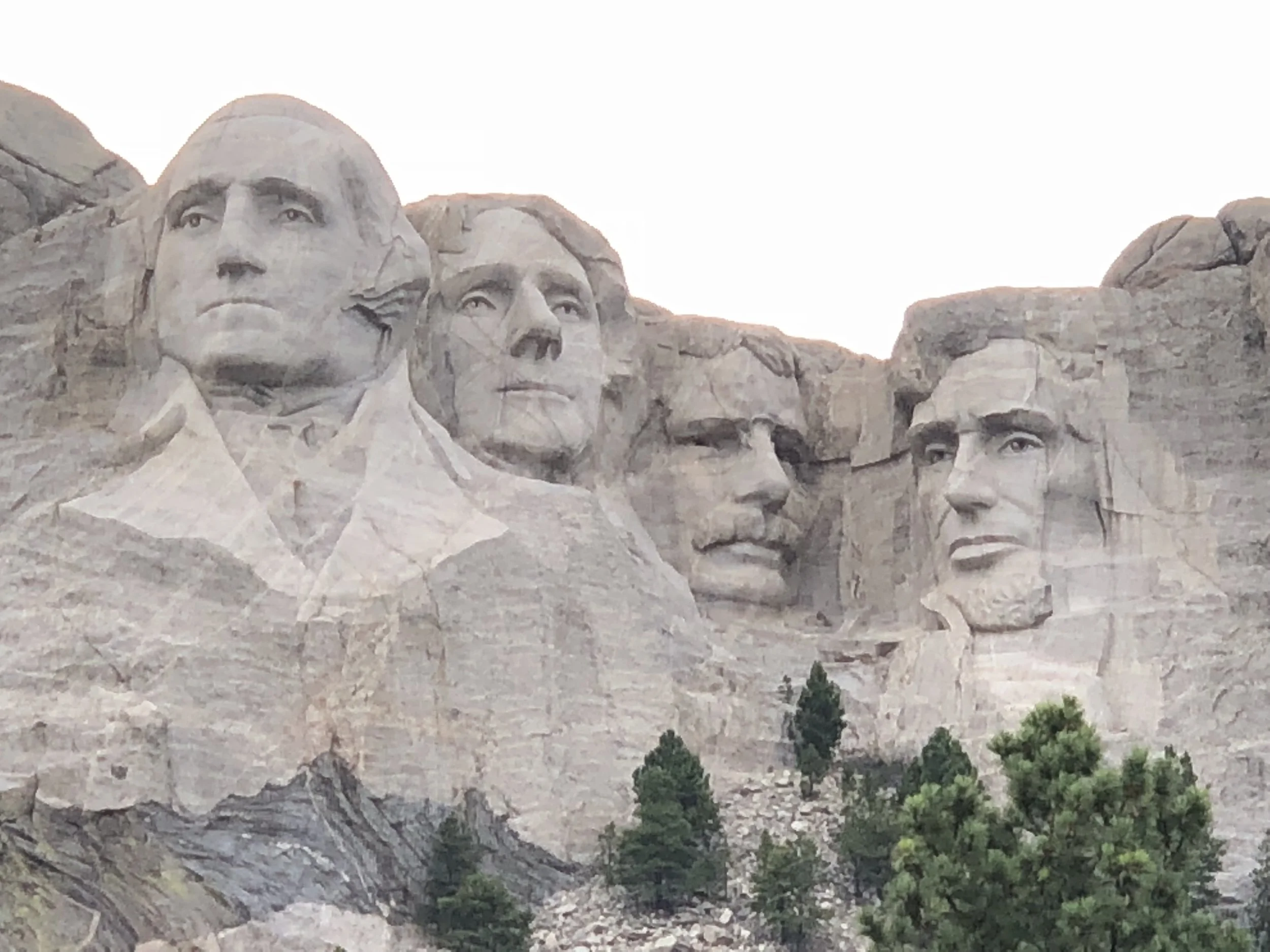
Pulling into the park, there the old guys were, George Washington, Thomas Jefferson, Theodore Roosevelt and Abe Lincoln, four presidents carved in stone on the side of the mountain. The sight was impressive.
I took a few photos, then lingered to absorb the scale of it, while sitting on the outdoor patio eating Buffalo stew from the park restaurant. The hot stew was filled with peas, carrots, potatoes, and tasty buffalo meat. The seasoned steam rising off it in the fresh mountain air transmuted the visual experience into one that reached all the way to my stomach.

LIGHTING CEREMONY AT MOUNT RUSHMORE - John W. Butler
( Five minutes read time or listen to the podcast by clicking the Buzz Podcast link. )
Continuing my drive yesterday, north on America’s Heartland Highway 83, I reached Pierre, the capital of South Dakota, late in the evening. I found a campsite next to the Missouri River. It was dark, so I didn’t really see the river, but I could hear it rippling.
I’m waking up slow this morning, with an occasional yawn. After making my coffee, I walk outside, promptly realizing this September day is too beautiful to waste inside. So I’m not.
After walking around a few minutes, I take time to sit at a metal picnic table overlooking the pebbly steep-sloping river bank, slowly sip my coffee and stare at the water swiftly flowing down the longest river in North America.
A variety of birds are flying over the banks of the river. Sparrows, Crow, and I think, Grakie. Others are pecking the ground for food just down from me.
On the subject of birds, South Dakota also has a good population of Ring-necked Pheasant. A dozen or so field hopped various points across 83 in front of ARGO and me. There will be a few less of those beautiful birds when hunting season comes around in a few weeks. Pheasant season is a big deal here and a boon to farmers offering hunting leases.
Sitting under the bright blue sky, I take it all in, breathing in the warm, pleasant September air.
I surmise the Lewis and Clark Expedition did something similar, watching the ancestors of these birds, when they arrived here in this same month of September, back in 1804, sans the metal picnic table of course. They camped nearby where the Bad River meets the Missouri.
However, the Lewis and Clark group didn’t relax for long. According to their journal notes, a little misunderstanding arose with the Lakota tribe, partially due to not having an interpreter. It was the first meeting for both. When weapons were drawn it almost brought a quick end to the whole expedition. Thank heavens for Chief Black Buffalo; he helps calm the situation. And everyone lived to tell the tale.
When I started this leg of my journey discovering America, I intended to drive on Highway 83 from Texas all the way to North Dakota. Stay only on 83. That was the plan, or as near to a plan as I got before setting out on the road.
However, you are aware, as well as I, plans made in the past do not always take into account the whims that strike us along the way. We have to deal with those internal pulls at the time they arise. I assume all of us who have at least a spoonful of wanderlust in our DNA have experienced this on our journeys. Right? Or is it just me?
I don't wanna be so rigid that I can’t alter my course, capturing a moment, or seeing a place I might otherwise regret passing by. Know what I mean?
Charles Lutwidge Dodgson knew this when he wrote, “In the end… We only regret the chances we didn’t take, the relationships we were afraid to have, and the decisions we waited too long to make.” He was better known by his pen name, Lewis Carroll. He wrote a few other things that are thought-provoking and fun, like Alice’s Adventures in Wonderland, and Jabberwocky.
So, looking at the map, I realize Mount Rushmore is only a few hours to the west. The president’s faces carved there is an iconic image burned into my mind. The photo is in every school history book. Now, the real thing was within my reach. I knew I would regret not seeing it.
Mount Rushmore is symbolic of our great nation and of human determination; both the artistic renderings of the four president’s and the raw feat of creating it on such a majestic scale. Guys hanging by wire-rope on the side of the granite mountain, chipping away to create art and a message.
Strikes me as sort of funny, the mountain was named after a New York attorney and businessman for obscure reasons when he was sent out to check land titles in 1884. As my European friend would say, “Very American.”
So I turned ARGO that direction, due west from 83. I was altering my northern course answering the tug of my internal compass and a mysterious element I’ll tell you about later. It would be another bucket list item checked off my list.
Late afternoon was well underway by the time I arrived in Rapid City, South Dakota. Only a stone’s throw away from Mount Rushmore. Make that, throwing the stone, then a the thirty-plus-minute drive up the mountain. I debated going now or waiting till morning.
It was the weekend, so I figured it would probably be more crowded than usual. Although it was well past the end of summer vacation time with most kids anchored back in their desks. When I was finished debating myself, I decided even though it was late in the day, why not go on up there? Maybe the real thing won’t be as big a deal as the photographs of it. If so I can go back to 83 tomorrow and continue on toward North Dakota.
So, I headed southwest out of Rapid City on Highway 16, climbing the mountain toward Keystone at the base of Mount Rushmore.
Getting closer to Keystone, driving under the arch of the glued laminated timber bridges, and then passing through the short tunnel, I have to admit, the anticipation was growing to see this thing in person.
Both the bridge and the tunnel were built during the depression by the CCC, the Civilian Conservation Corps, during the Great Depression.
My first glimpse was from a turn in the road.
“It’s real,” I mumbled. Funny, that is what came into my mind. Guess we hear about so many things that turn out not to match the hype. Mind-blowing when something is as promised.
Pulling into the park, there the old guys were, George Washington, Thomas Jefferson, Theodore Roosevelt and Abe Lincoln, four presidents carved in stone on the side of the mountain. The sight was impressive.
I took a few photos, then lingered to absorb the scale of it, while sitting on the outdoor patio eating Buffalo stew from the park restaurant. The hot stew was filled with peas, carrots, potatoes, and tasty buffalo meat. The seasoned steam rising off it in the fresh mountain air transmuted the visual experience into one that reached all the way to my stomach.
Way to go! Thank you United States National Park Service. Good job making my visit to Mount Rushmore an easy, enjoyable and, surprisingly, tasty one. And, of course, a historical, educational visit also.
Dusk was approaching, so I hung around for the night lighting ceremony and ranger talk. It was fittingly patriotic and inspiring.
I decided to return the next day when I learned one of the guys who did work on the mountain in the late 1930’s would be at the park the next day. A CCC guy. Last survivor who worked when the talented genius sculptor, Gutzon Borglum, was directing the project along with his son Lincoln.
Driving up the next day, I felt the same sense of awe approaching the top of Mount Rushmore. I was excited to be able to talk to the last survivor of the Great Depression era work crew.
Nick Clifford helped from 1938 to 1940 build the wood studio for the sculptor, as a driller and as a winch operator on the top of Washington’s head. But he was mostly hired for his baseball abilities as right fielder and pitcher. You see, baseball was a passion of Lincoln Borglum. The teams were competitive, so Nick was recruited to bring in some wins for the team, the Rushmore Drillers.
Doing an interview with Clifford would be fun. Hear first-hand stories about the baseball team. What was it like to work on the sculptures? What was life like back then? He has to have a ton of good stories.
I met Nick at the gift shop at the monument. Told him I was excited to meet him and asked to do a brief audio or video interview with him now or at a later time.
He said, “No,” without any hesitation or an eye blink.
He wasn’t in the best of moods. I could tell it wasn’t a good day for Nick. I smiled, explaining how it would benefit children and history. He listened without looking at me. I asked again in the most sincere, gentle and polite tone of voice as I could summon.
He said, “No.”
—————
(I spent one more day in the Mount Rushmore area in the Black Hills at Grizzly Bear Creek. Tell you about my rude awakening there in my next post. Sign up for email alerts when I post on my blog and vlog at JohnButlersBuzz.com )

Tourist from China want a photo with a Texan - John Butler at Mount Rushmore
RUDE AWAKENING AT GRIZZLY BEAR CREEK
It was pitch-black-dark by the time I pull into campsite number ten. Both clouds and the tall trees in this thick national forest blocked any light from above. My objective is to not hit any trees as I drive slowly next to the metal stake with my designated campsite number.
I’m really sleepy now. I make my bed in the back of ARGO, then lay there reading for less than a few minutes. With little haste, the weight of my eyelids cannot be pushed back any longer.
“I’ll sleep extra late,” I mumble to myself. My last words on my descent into unconsciousness.

Grizzly Bear Creek - By John W. Butler
(5 minute read time or click on Buzz Podcast link to listen to the audio version)
It was almost dark, with a sinking sunset behind Mount Rushmore silhouetting the four presidents. I took one last look as I turned to walk down the open-air corridor displaying all the state flags overhead.
Instrumental orchestral patriotic music started playing over the park sound system. About the third song, they struck up, Yankee Doodle Dandy.
That song evokes several emotions in me. I instantly flashback to a happy memory of a 4th of July weekend at a house in Beverly Hills. I was there with my newlywed wife, Beverly, and my old friend, JD Hinton.
JD was known to all of us as Dave back then. We knew each other from high school days. We also started in broadcasting near the same time as teenagers at different stations. He left Texas with his talents as a songwriter and singer, with the determination to become an actor in Hollywood.
We were all young, in our mid-twenties, with the world in front of us. And, on this particular 4th of July, we were celebrating the occasion with a fun afternoon party centered around watching the famed Jimmy Cagney in Yankee Doodle Dandy. The title, of course, is based on a song favorite during the American Revolution. The movie setting takes place after WW II.
At that party, the guests filled the living room chairs, and many of us sat on the floor to watch. Hollywood types don’t just watch a movie, they absorb the art of in detail, marveling when it is done well. We laughed and cheered as Cagney and cast stirred our patriotism for America, along with the value of bonding friendships.
So now, standing all by myself at Mount Rushmore, listening to Yankee Doodle Dandy, I was brimming with emotions. A time-warp, connecting dots in my life; one from grade school seeing photos of these Presidents carved on this very mountain in front of me, to a 4th of July party in California.
Admittedly, I felt an inner stirring of gratefulness for all this exceptional country has made available to me and everyone who is lucky enough to live here. Then, the feeling of being alone drifted down on me, standing in this granite enclave of history. The rustling sounds of the fifty state flags lining the walkway overhead, while the mood-provoking song over the loudspeakers grabbed me by surprise.
The lighting ceremony was about to begin. I had seen the lighting ceremony the night before, and also, I was feeling tired.
After spending time walking around Mount Rushmore, I thought I might check out a National Forrest campsite here in the Black Hills to avoid the drive back down the mountain. A ranger told me Grizzly Bear Camp was one not too far away.
Mostly these National Forrest campsites are booked in advance. Months ahead for the popular ones. But, I’ve had good luck with many of them as a last minute “walkup.”
Leaving the parking area of the memorial, I started down the mountain on 244, then turned right on 16, back up towards Grizzly Bear Creek.
The darkness of night had settled in by the time I reached the graveled entry into Grizzly Bear Camp. I slowly eased ARGO by the campsites where people had their tents pitched, some huddled around their fire pits. At one, a young guy was playing guitar for his friends. At another, small lights were hung around on tree branches in a celebratory fashion. Otherwise, it was pitch dark midst the tall pines.
There were two empty campsites I passed so it looked like I might be in providence’s good graces once again. Stopping at the campsite marked “camp host,” a kind lady in her upper years stepped out of her RV and greeted me.
“Looks like there are a few empty sites,” I said. “Any chance one is available tonight for me?”
“You’re in luck,” she said. “Someone left early, and someone else failed to arrive.”
“Perfect, I’ll take one.”
“You can have your pick of the two.”
“Guess I’ll take number ten.”
It was pitch-black-dark by the time I pull into campsite number ten. Both clouds and the tall trees in this thick national forest blocked any light from above. My objective is to not hit any trees as I drive slowly next to the metal stake with my designated campsite number.
I’m really sleepy now. I make my bed in the back of ARGO, then lay there reading for less than a few minutes. With little haste, the weight of my eyelids cannot be pushed back any longer.
“I’ll sleep extra late,” I mumble to myself. My last words on my descent into unconsciousness.
At 5:30 am I’m still sound asleep. Then suddenly, a thunderous noise from outside ARGO, directly against her silver skin, breaks the silence of my sleep.
Wham!
Wham!
Wham!
Three repeated impacts against the side of ARGO startles me from my near coma. I’m not sure if it’s a dream or a real danger. A pause, then the noise repeats.
Wham!
Wham!
Wham!
Now, I’m more awake; at least enough to perceive that the disturbing noise is not coming from a dream. It’s real. Have the grizzly bears returned to Grizzly Creek?
Wham!
Wham!
Wham!
Now, I’m desperately trying to push my heavy metallic-like morning fog away so I can deal with whatever creature is attacking. The next thing I hear makes me quickly realize it is not a grizzly bear. It’s something much more dangerous and unpredictable: a human.
“Wake up,” a voice commands in Nazi fashion.
“Who’s there?” I shout back. But there is no answer.
Wham!
Wham!
Wham!
No answer still. “What do you want?” I ask again.
“I want to talk to you,” a forceful, angry voice, in a near rage, comes back.
“Just a minute,” I manage to say, as I glance for assurance at my metal flashlight which doubles as a self-defense night-stick. It’s within easy reach. I frantically stand up putting on my pants and belt.
The grog of my half-awakened state makes me perceive my actions as if I’m pushing against the force of water. Voices sound like a soundtrack playing in slow-mo.
I slightly crack open the sliding door on ARGO. A thin wire-like man in oversized denim, wearing a dense wool brown plaid shirt, topped with a tattered western hat is standing outside the door. His size doesn’t fit with the loud banging noise he was making.
“What do you need?’ I ask with a sleepy and puzzled tone of voice.
“Do you see that rock?” He points to a rock on the ground, just to the right side of ARGO. I look down and do indeed see it.
“You are on the left side of that rock,” he proclaims with a religious piousness that confuses me more.
“Yes sir, I do see that,” I answer.
“Well, you are supposed to be on the other side of that rock!” He points firmly at the right side of the rock. “Campsite ten is on the right side of the rock.”
“Okay, well, I’m sorry,” I say, still trying to make sense of the early morning arousal. “It was pitch dark when I came in last night, and I guess it wasn’t obvious which side of the rock to be on.
“Well, it is obvious!”
“I was trying to avoid hitting any trees in the dark.”
“Well, you have to be on that side,” he affirmed, again point to the right side of the rock that was easy to see with the morning light. He turned and briskly walked away huffing like a dog who has barked away another dog. An air of an elevated pride lifted him up an inch or two.
“I bet I’m not the first to do that,” I said, trying to make a connection with the old fellow. Possibly calm him down a bit.
“Yes, you are the first!” He said without missing a step in his stride or turning to look back at me.
I wanted to say something clever, bordering on stinging, as a parting jab. My better nature took hold. Kept my mouth shut. Not prolong the exchange.
He didn’t tell me who he was, but it was apparent he was the manager at the campsite. The husband of the sweet lady who checked me in last night.
It struck me that I probably helped this guy complete his morning constitutionals. He most likely wakes up every morning looking for someone to let off steam on in the camp who didn’t park to his exact specifications, then takes a dump and has his coffee and eggs. After that, he’s likely a decent amicable fellow.
He kept me from that long-awaited morning sleep in the solitude of the forest I wanted, but maybe that was a good thing. I quickly brushed it off, made coffee and ate a protein bar. Cranked up ARGO and moved her to the right side of the rock.
I walked around the campsite sipping my coffee. A soft breeze vibrated the leaves on the brush and undergrowth around me making a pleasing white-noise background sound. The cool air felt soothing across my bare arms and face.
In front of me, a bouquet of pine needles dropped from the overhead branches. Breathing the freshly produced oxygen from the forest was almost intoxicating. A big difference from the belching toxicity of the city.
I continued sipping my dark hot coffee as my senses took in the surroundings, enjoying the rest of, what turned out to be, a very reasonable start to a new day.
Now the thought strikes me, I should find that old geezer who rudely and unceremoniously banged on my door, rattling me awake, chastising me for parking on the wrong side of the rock at Grizzly Bear Creek.
I should find him and thank him. He turned out to be an angel. An angel who called me up from my slumber into a glorious morning I otherwise would have missed.
But, again, my better nature tells me to leave well enough alone.
Time to move along, on down the road of America’s Heartland Highway.
Thanks for following the journey on JohnButlersBuzz.com
Hope to see you down the road.

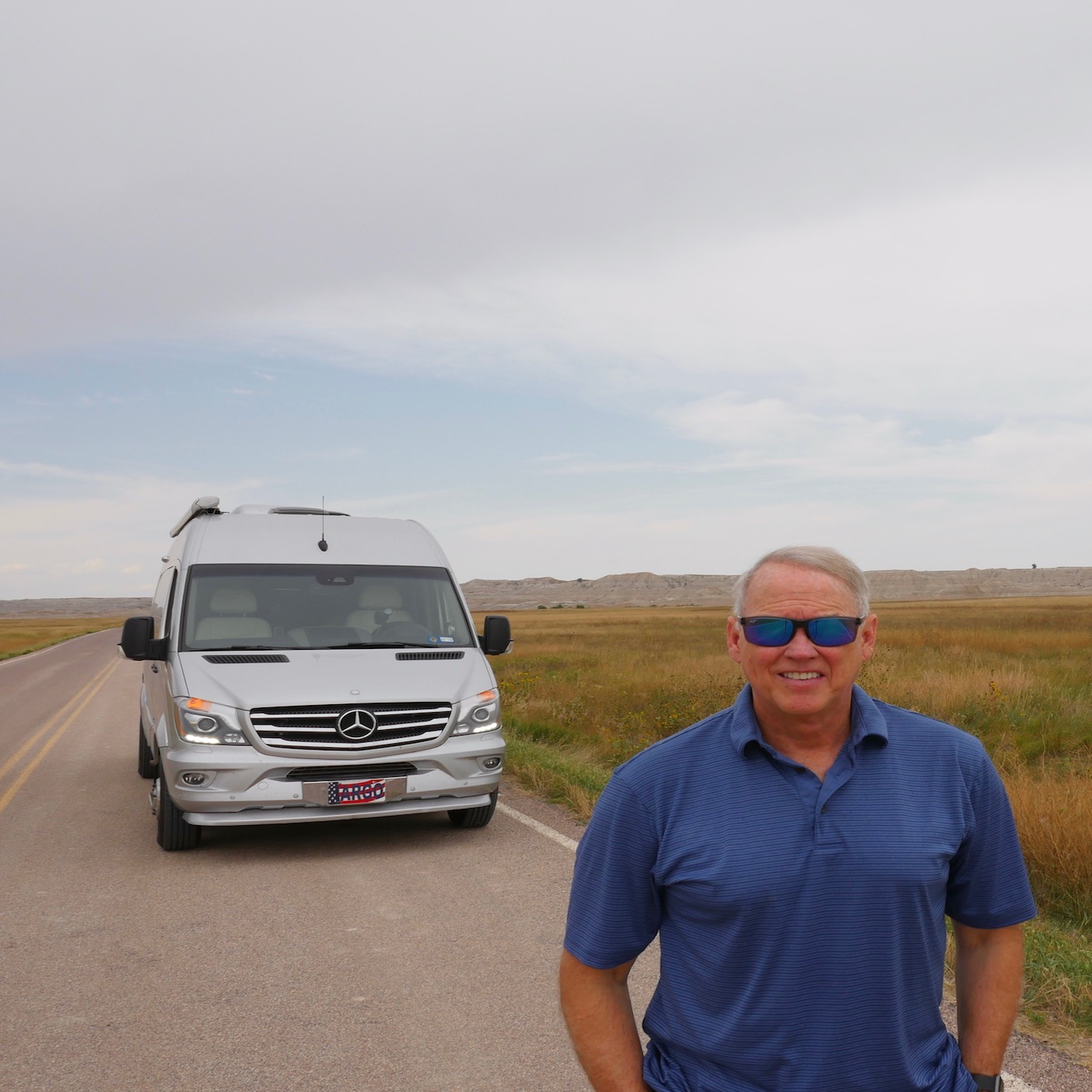
John Butler at Grizzly Bear Creek in the Black Hills of South Dakota
STRANGER IN NEBRASKA SANDHILLS
He eases the truck up near me. I wave to signal I’m a friendly-type, hoping, of course, that he’s a friendly-type too. Don’t want to get shot out here for trespassing, or for any reason. It does cross my mind.
He stops short and rolls his passenger side window down as he leans in my direction.

(5 minutes read time)
After leaving Kansas, I stopped in Valentine, Nebraska, then continued north on Heartland Highway,83, into the Sandhills.
Some people separate the words, sand, and hills. I’m told by locals, the name is the two attributes put together. Gives the place a proper name: Sandhills.
So, to be correct, I’m looking at the sand hills of the Sandhills. Of course, nobody knows if you have it correct or not until you write it down.
I do know, when a guidebook called Highway 83 the “Road To Nowhere,” this area probably had something to do with it.
Oddly, I don’t see much sand as I drive. The rolling dunes are grass-stabilized, covered with mixed vegetation that has adapted to grow in sand. In addition to the grass, over 720 variations of plants can be found here.
Should be great for farming, but it’s not. Too big of a challenge in this soil. Settlers found that out in the in the late 1800’s.
Farming was attempted again in the early 1900’s when the Kinkaid Act offered 640 acres to homesteaders. This program also led to the formation of Nebraska’s largest African American settlement, DeWitty.
Around 1930 the homesteaders, called Kinkaider’s, gave up and moved on.
Although farming was difficult, the land is suitable for grazing, with a population of over a half-million cattle. Coyotes, badgers, mule and white-tail deer love it too, along with wild turkeys, meadowlarks, bats and skunks. And so do dragonflies, mosquitos, flies, and grasshoppers. ARGO and I encountered all of them as they met their fate in unceremonious splats on ARGO’s grill and windshield.
Splat, splat, splat, and spat.
John Butler’s Buzz
Join me on the journey at JohnButlersBuzz.com
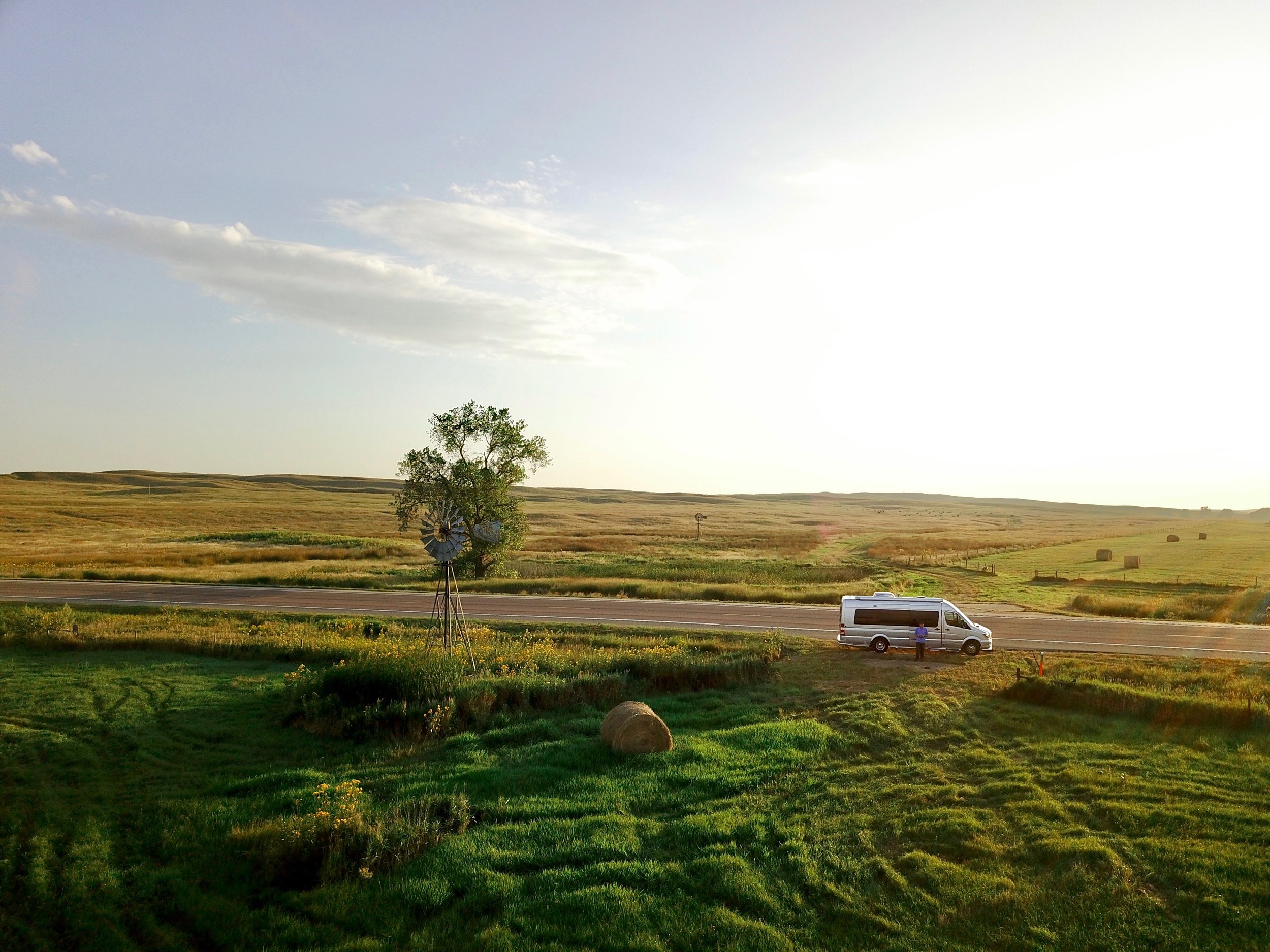
Driving through the Sandhills, there are lonely stretches where you can look to your left or right, and see nothing but hills. I think I can make out the curvature of the earth in the distance. Seems evident as I squint. But, as I say, only hills in between me and the curve.
It’s understandable why this area could rightfully be called the middle of nowhere. Even so, there is a beauty to the place that is peaceful and calmming. That is if you have proper transportation standing by to make your way out of it. I wouldn’t want to walk out of it. And I wouldn’t want to run out of gas here (taking a second glance at my fuel gauge).
There’s not much of a shoulder to the road, but there are random turn-offs that ranchers use to check their cattle. I pick one of these turnoffs, park, and climb out of ARGO to take a closer look around.
Feels good to stretch my legs. It’s quite. Only an occasional vehicle passing by on 83. The thought strikes me it’s an excellent place to fly Air-ARGO, take a look around from above.
The land is strange to me but beautiful. It's even more strangely beautiful from above. The eyes of the drone see it all.
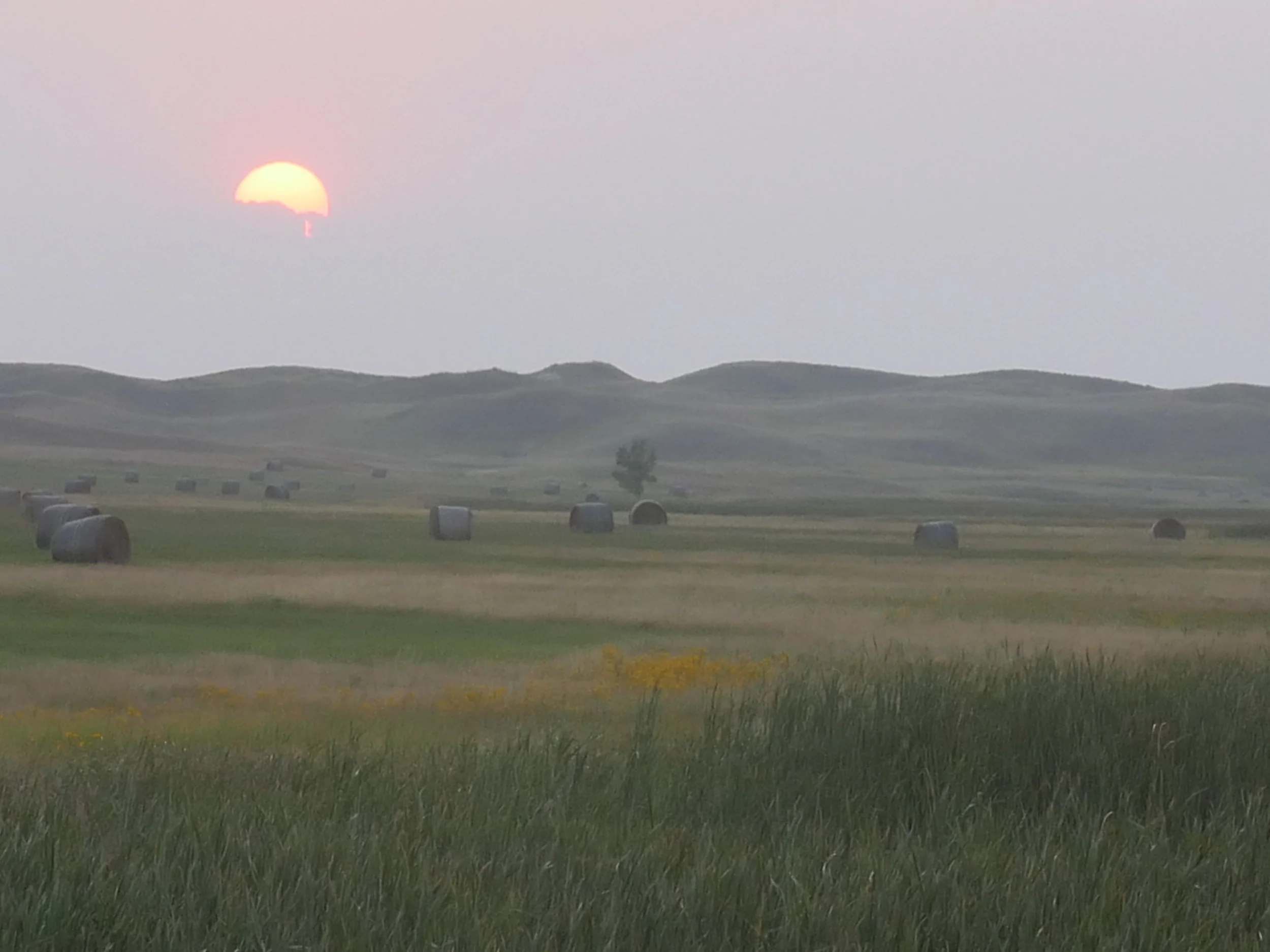
The landscape is rolling Irish green and amber. I’m surprised that in August, with no irrigation, much of the growth is a hydrated green. I find out later, these dunes are sitting on top of the Ogallala Aquifer. Water is down below and shows up in low areas to make small lakes.
Cattle nonchalantly stand around. Eating, resting, eating. They must think they are in the biggest-green-grass-candy store in the world. They graze continuously and contently. A hundred or more cows congregate near a large round water tank. Each chewing their cud.
Cows are nearly always chewing their cud. At least eight hours a day. That’s because they have to chew their food twice to digest it. Takes about 8 hours a day and forty-thousand jaw closings.
A sip of cool water between all that grass eating must taste really good to the beautiful bovine. Apparently, the cows aren’t too picky. They don’t seem to mind that the water is covered with some sort of slimy moss floating on top. But, it probably acts as a barrier between the sun and the water, keeping it a little cooler.
I take Air-ARGO down for a closer look at the tank from above, then fly it over the land into the distance, higher and higher.
As I stand looking into the drone control viewfinder, a lone truck pulls off 83 onto the the dirt road towards me.
Startled for a second, my focus shifts from the viewfinder to the flatbed red pickup truck. At the wheel is a lone driver, an older man, wearing a cowboy hat, partially shading a leathery-faced dour expression.
He eases the truck up near me. I wave to signal I’m a friendly-type, hoping, of course, that he’s a friendly-type too. Don’t want to get shot out here for trespassing, or for any reason. It does cross my mind.
He stops short and rolls his passenger side window down as he leans in my direction.
“Checking on what you’re doing,” he says without a smile.
“Making my way up 83,” I say with a smile. “Stopped to fly my drone over the land and take some pictures.” I point to the sky, but the drone is so high up it can’t be seen or heard.
“A drone?”
“Yes sir,” I say with another smile. I add a confident nod like I know what I'm doing. I don't know of course.
I’m relieved when he returns a partial smile back. More of a puzzled, unexpected amused look, rather than a smile. But it’s something. A crack in the leather.
“Flyin' a drone up there?” He nods. His head tilts to the side, as his body language says, well, that’s a new one.
“Yes sir,” I say, as I look up toward the sky hoping I can see my drone to point to it and show him. “I hope it’s okay to do this. Just thought this would be a good place to use it.”
He pauses, thinks about it.
“Oh sure,” he says, leaning forward with his arm resting on the steering wheel. “It’s okay by me, no problem.”
“Thanks, I’m just flying it for a few minutes, then heading on north.”
“Where ya from?”
“Texas!”
He, of course, knew that, because I saw him glance at my license plates, but he was confirming it. He seemed to loosen up when I said, “Texas!”
“We rounded up these head here,” he offered, pointing with pride, toward the cattle near the water tank, “to load up tomorrow.”
“Some beautiful cows,” I complimented. It was evident we were making a Texas - Nebraska connection. If I'd been from New York, it would be different.
“Yep, we’re proud of ‘em," he bragged. "I was driving by and wanted to check ... see what you were doing. You take care now.”
“You too,” I said, waving a friendly bye-bye, feeling relief that I wasn’t in trouble with my drone flying. “Thanks again and nice talking to you.”
He acknowledged me back let his foot off the brake, adjusted his hat, then eased his truck slowly back to 83 and continued on in the direction he was going.
I frantically turned my attention to the controller to locate Air-ARGO up in the sky. The altimeter indicated it was 200 feet high on the opposite side of 83 with the camera pointed in my direction. As I brought it closer and lowered the altitude, I felt better when I could hear the buzz of the propellers.
I flew it a little longer till the battery warning started beeping at me, sounding the alarm. I manipulated the joy-sticks to bring little Air-ARGO home. Landed her, within a few inches, right where she had taken off.
Still amazes me every time I fly her, as she goes away and comes back home. An admiral and an honorable trait. One missing in many relationships today.
Today I got a birds-eye view of the dreams found and dreams lost in the Nebraska Sandhills. Met a local rancher. And drove away with a ton of deceased insects on ARGO's windshield.
So, it’s on down the road I go, without expectations or reservations, discovering America one story at a time. Still headed north on 83, the path I’ve dubbed, America’s Heartland Highway. Subscribe for email alerts when I post and come along with me at JohnButlersBuzz.com
IN THE LAND OF TWISTERS & OZ
Sometimes you have to leave a place to learn how special it is to you.
A girl named Dorthy Gale found that out in a most peculiar way. I’m on my way to visit Dorthy’s house today.
Driving north on Hwy 83, the one running smack dab up through the middle of America, I made it through the Texas Panhandle, crossed the Oklahoma Panhandle, and now I'm in the frying pan of Kansas.
As I have mentioned before, 83 has been called the “Road To Nowhere.” But I call it Heartland Highway,

Sometimes you have to leave a place to learn how special it is to you.
A girl named Dorthy Gale found that out in a most peculiar way. I’m in route to visit Dorthy’s house today.

Driving north on Hwy 83, the one running smack dab in the middle of America, I made it through the Texas Panhandle, crossed the Oklahoma Panhandle, and now I'm in the frying pan of Kansas.
As I have mentioned before, 83 has been called the “Road To Nowhere.” But I call it Heartland Highway, for reasons that become apparent when you drive any significant portion of the 1,885 miles stretching from old Mexico to Canada, right through the center of the United States.
Kansas is, possibly, the heart of Heartland Highway.
It’s been home to the Kickapoo people, Kaw, Cheyenne, Potawatomi, and other tribes. Don Francisco Vasquez de Coronado was the first European to visit, along with a small group of explorers in 1541, looking for the “Seven Cities of Gold.”
My trusty steed-on-wheels, ARGO, groomed by Airstream and powered by a Mercedes diesel engine, transports me past fields of corn, soybean, wheat, hay, sunflowers and a whole lot of Broom-corn, switchgrass, bluestem, and Indian-grass.
I’ve changed into a fresh brown short-sleeved khaki shirt, which harmonizes more with the farmers and ranchers when I stop at the local cafes along the way. But the cargo shorts and loafers with no socks still present a juxtaposition. No one has said anything; just guessing by the occasional once-over glancing from locals. It’s a long drive, so I’m more concerned with comfort. Know what I mean.
The state of Kansas continues to be noted as the beginning, and end setting of a Hollywood movie made way back in 1939, The Wizard of Oz. The story where a twelve-year-old girl, Dorthy and her dog, Toto, are transported from her aunt and uncle's farmhouse, suddenly, and not so elegantly, via tornado, to the mysterious fantasy land of Oz.
The story is based on the book by L. Frank Baum, published in 1900, the Wonderful Wizard of Oz. His story captured readers imagination, and it became a hit with the first printing. The story was brought to life on the big screen in a dramatic, innovative way in 1939, engaging audiences on a worldwide scale. It’s what movie critics call, an “essential.”
If you haven’t seen the movie, then cancel whatever nonsense you had planned to watch on TV tonight, locate a copy of the Wizard Of Oz movie, throw a bag of popcorn in the microwave (adding extra butter of course), and watch. You’ll be taken on a beautiful journey.
Sixteen-year-old Judy Garland is endearingly adorable in the lead role of Dorthy Gale. The characters are archetypical of good and evil, from Glinda, the good witch, to the Wicked Witch of the West.
And the film’s special effects are a marvel, unique in the late thirties, and still, stand up today. Yes, kids, late thirties, well before computer generated movies with exploding-after-effects. Even the use of color was used in a special way, with the tornado scene in black-and-white, with Oz in color. And kids, this will throw you a curve, cell phones only existed in cartoons; the two-way-radio version worn on Dick Tracy’s wrist.
So here I am north of the Kansas/Oklahoma state line in the sweet little town of Liberty. I'm told it's a must-stop-place on Highway 83, the Heartland Highway, for at least one reason, to walk through Dorthy's House and the Coronado Museum. So, I guess I gotta go see it.
One resident of Liberty I chatted with at a local cafe, shared a little background letting me in on the secret: "the town first rejected the Oz movie mystique hung on them, then decided to embrace it." Well, whether they would have decided to or not, the characters of Dorthy, her dog Toto, Annie Em, the Scare Crow, the Cowardly Lion, the Munchkins, the Wizard and all the rest of the cast, became linked forever to Kansas.
Tornados are also linked to Kansas too. Each county in the state has had approximately 30 to 50 tornados since 1950, according to the National Weather Service.
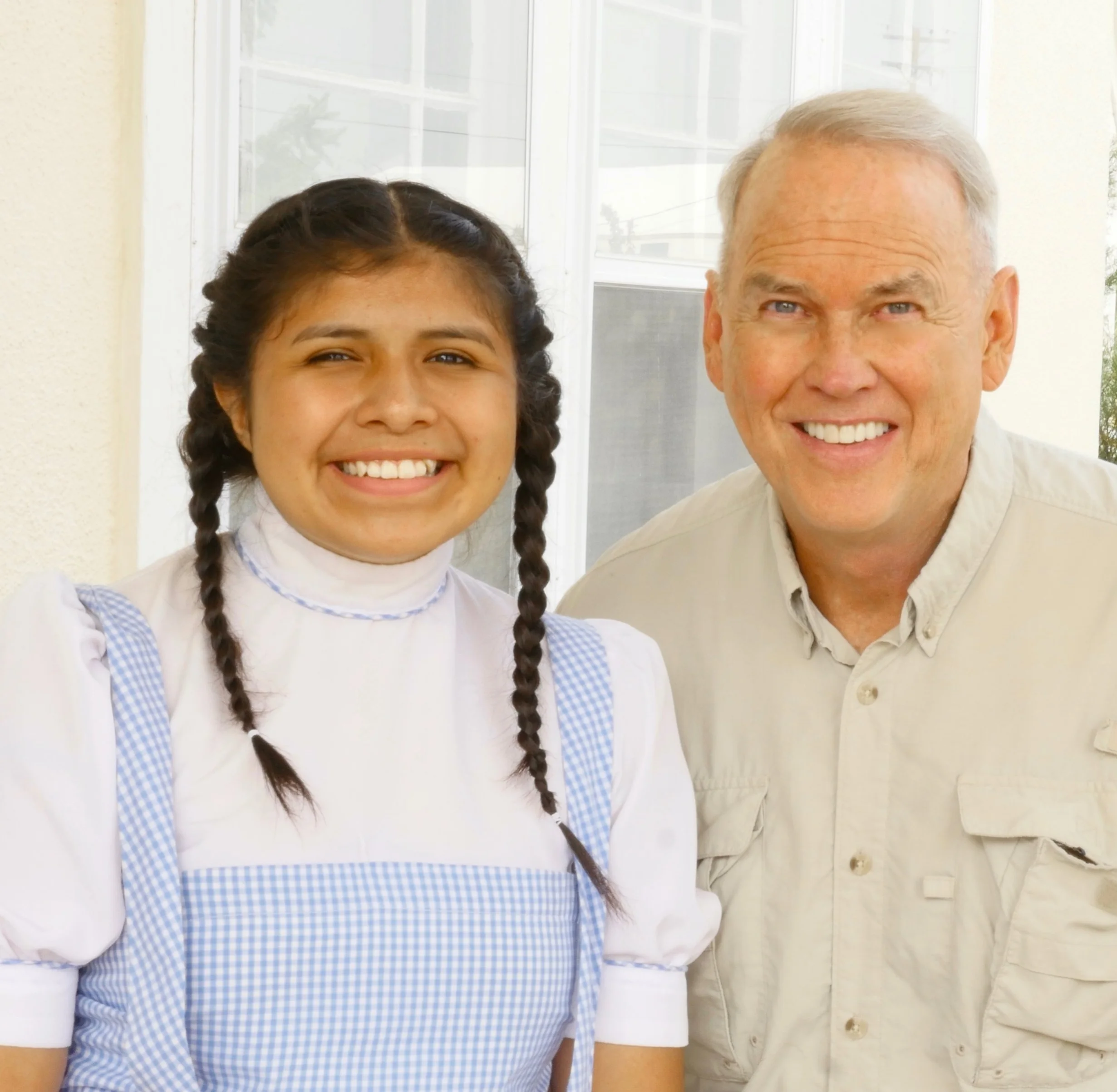
So, here I am on the walkthrough of Dorthy's farm home and the diorama recreating the Land of Oz. All beautifully camp-shtick. I'm being led by one of the adorable teenagers playing the role of Dorthy Gale. I’m told not to use her real name, so mums-the-word, so to speak.
This girl is part of the Dorthy Program, and I find out later, that is one of the cool educational dimensions of the place. Girls from middle school and high school are accepted into the program where they memorize lines from the movie, learn to tell the story, and guided to develop their confidence and speaking abilities.
Once they pass the test, they are bestowed with the distinctive farm-style gingham dress; step into the famous ruby-red slippers and become the personification of Dorthy Gale, the star of the story. One of these young girls is my personal tour guide today, narrating the journey of the fictional Dorthy, who was taken suddenly, amidst a violent storm, from a small Kansas farmhouse to the Yellow Brick Road in the mystical Land of Oz.
Mind you, this tour is not a Hollywood mega-budget production. It’s a fun odyssey by foot through adjoining rooms staged to tell the story. Starting in a typical Kansas farmhouse living room, we experience an approaching tornado as the windows begin to rattle, curtains whip erratically, lights flicker, and the wind roars louder and louder. Past the curtains thrashing back and forth over the window, there is a picture of an approaching tornado.
Now at this point, and on a personal note, very unexpectedly … this ominous simulated turmoil triggered a terrifying memory for me.
When I was six years old, I experienced the real thing.
My family was living in Durant, Oklahoma for a few years. It was dinner time, late afternoon on an April day, just before six o'clock. Mom was in the kitchen cooking fried chicken, along with black-eyed peas, and mashed potatoes and cream gravy. An apple pie cooling on the counter. All the mouth-watering, hunger-inducing aromas of a home cooked meal wafted the warm, unusually calm, afternoon air.
And yes, that is the way I grew up, with home-cooked meals every day (yes I know … strange in today's culture, at least in the USA).
So, nothing unusual about the day as I stood in the kitchen looking out the back screen door. My little six-year-old mind was deliberating, not sure if I wanted to go out to play for a few minutes, or talk mom into a pre-dinner chicken drumstick before we sat down for dinner around the kitchen table when my dad got home from work.
“Hey mom, that’s a funny looking cloud?” I said. She stepped away from the stove to a take a peek out the screen door to see what I was talking about. For a few seconds, mom just stood there next to me, staring out at the sky, processing what she was seeing. A thin tube of a cloud was wobbling from the wild-blue-yonder, all the way to the ground, and out of an otherwise clear sky. The rotating shaft was coming right toward us. It was getting bigger. I could now see stuff flying up from the land around the bottom of it.
“Oh my God,” she screamed in a panicked voice. “That’s a funnel cloud … a tornado!”
I pushed the screen door open to go outside for a closer look. Mom instantaneously grabbed my arm, pulling me away from the door as she turned full-tilt to extinguish the gas flames on the stove-top burners. She led me lickety-split into the center of the house while excitedly yelling for my younger sister to come quick. Cathy was playing dolls in her room. Cathy ran into the room to see what all the commotion was about, then grabbed on to mom.
“Get down!” Mom commanded as she pushed us toward the floor with her arms around us. “Cover your heads … get down!”
We did, and my mom started saying the Lord’s Prayer very intently, leading my sister and me. And it was recited with immediate, intense sincerity.
At six-years-old, I didn’t fully understand what was going on, but I knew my mom was scared for us. And that frightened me. Danger was lurking. I could feel my heart racing. My sister started crying. My mom did too.
Just like in Dorthy’s tornado simulation, the windows rattled, curtains flapped around. The wind picked up speed rapidly, and at the peak, the noise was so loud it sounded like, similar to how others have described, a freight train in the sky going right over our house. The loud noise faded almost as fast as it came. The air was still again. Silence.
We had been in the path of the tornado, but it shifted course, narrowly avoiding us.
Our house had some roof damage, but the neighbor’s home suffered more. I remember a tree was knocked down nearby. Limbs and debris were scattered about the yards.
My dad rushed in the door hugging us all tighter than ever.
It’s all vividly archived in my memory, along with the chicken dinner mom was making. When we finally sat down to eat, my mom was still very emotional, saying several times, “this meal could have been our last.” Later we found out three people were killed.
The next day my dad drove all of us to the nearby areas to survey the destruction. It’s hard to believe such devastation was caused by that funny cloud in the shape of a funnel. And by happenstance, I had seen it coming through the screen door.
When the tornado came to Dorthy’s house in the fictional story, she was knocked unconscious, before being swept up into the sky. She found herself transported to a strange land, a place that morphed her black-and-white Kansas farm world into one filled with color in the Land of Oz.
It was exciting, both the place and the new friends she met. But Dorthy, as a result of the terrible, yet color filled eye-opening ordeal realized what was most important to her, she wanted only to return home, to her family in Kansas.
Unlike Dorthy, I wasn’t knocked out or transported to any magical place via the tornado I lived through. But I do know what Dorthy came to realize. My family, my home, is the most valuable thing I have in life. Not the house, which can be blown apart in an instant by a funny cloud, but the most valuable thing of all: home, and all the word means. Home is the place where someone cares about us; where we are protected, understood and loved.
As Dorthy famously says in the final act of the movie, “There’s no place like home.”
ON THE ROAD AGAIN WITH BONNIE & CLYDE
Some writers have called Highway 83, “The Last American Highway.” One guidebook dubbed this highway, “The Road To Nowhere,” which, in all due respect to the travel guide, seems disparaging, belittling, and frankly, stupid. I wasn’t the best student in my high school geography class, but I can see the road does go somewhere, and on both ends of it: old Mexico to Canada. Two exciting, diverse places, albeit, one very violent, the other passive and peaceful. So in my humble opinion, this demeaned Highway 83 needs a more notable name.
I’m naming it: HEARTLAND HIGHWAY.

Well, I’m on the road again. Cue Willie Nelson’s song.
What, wait-a-minute?
I’m just told that Willie’s music publishers want some green-dough, some cabbage, some buckaroos, to play his song in public. That’s okay, I’ll just mumble the words and hum it in my mind. Trouble is, that song is hard to get out of your head once you start it playing inside there. Know what I mean?
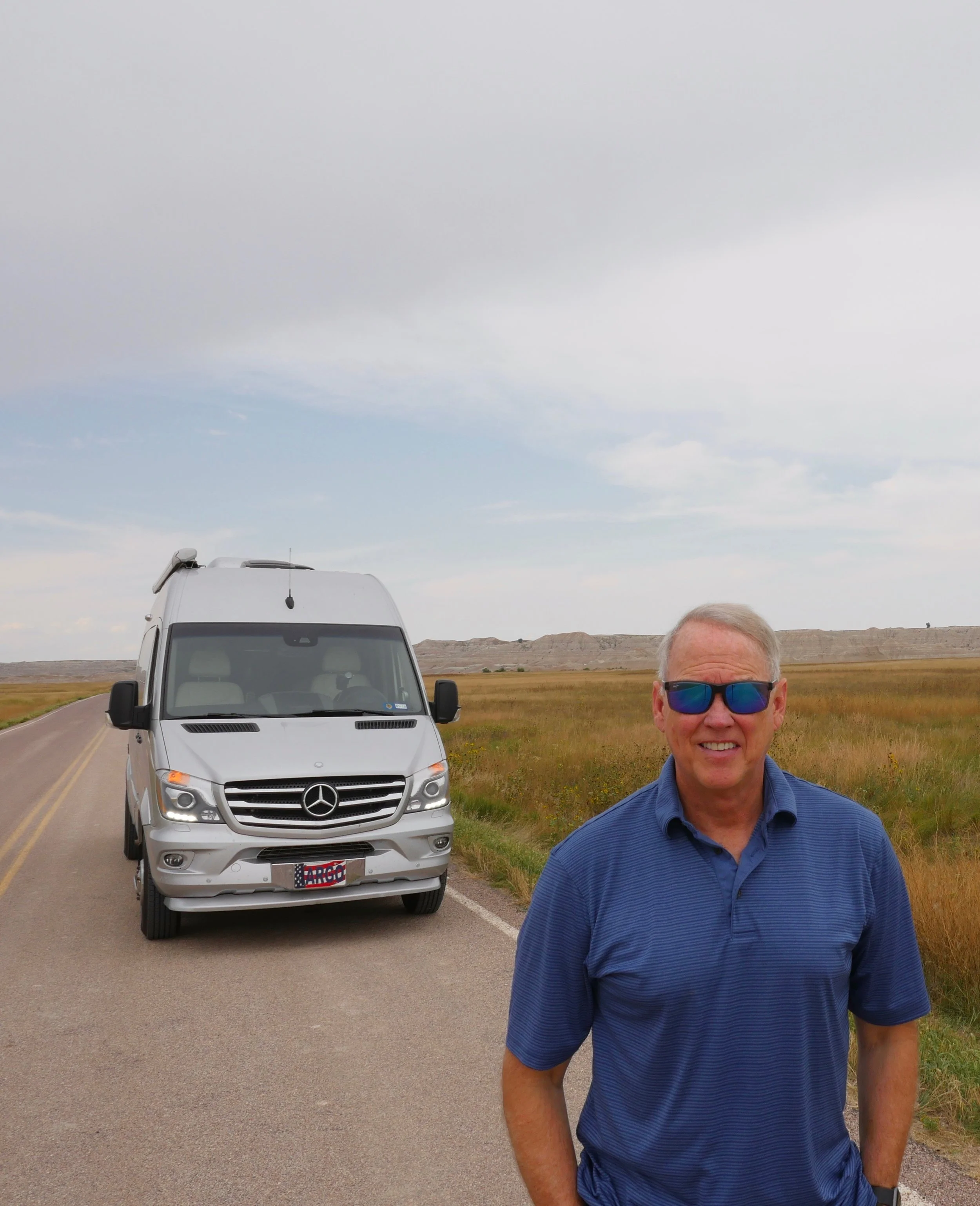
I’m driving north on Highway 83 in ARGO. Wearing an un-tucked light blue Columbia fly-fishing shirt, khaki cargo shorts, and loafers without socks, I am easily identified by locals along the way as a “yur-not-fum-round-here” guy.
If you want to quickly find the road, I’m traveling. Pick up a paper map of the U.S.A. (remember those?). If you can’t find one, do this mentally: hold the map out in front of you with the west side of it in your left hand and east side in your right.
Yes, of course, with north at the top.
Now, fold it in half from left to right (ah, note for dyslexics: a right to left folding of the map also works, with, of course, north still at the top), then crease it in the middle. Now open it back up.
Look at the crease in the middle. Highway 83 should be right there in the crease, or, at least, close to it, just to the left side, from top to bottom.
Some writers have called Highway 83, “The Last American Highway.” One guidebook dubbed this highway, “The Road To Nowhere,” which, in all due respect to the travel guide, seems disparaging, belittling, and frankly, stupid. I wasn’t the best student in my high school geography class, but I can see the road does go somewhere, and on both ends of it: old Mexico to Canada. Two exciting, diverse places, albeit, one very violent, the other passive and peaceful. So in my humble opinion, this demeaned Highway 83 needs a more notable name.
I’m naming it: HEARTLAND HIGHWAY.
It’s a more fitting moniker don’t you think? Much more appropriate, especially when you come to know it for what it really is and what it represents for America and the world.
Highway 83, Heartland Highway, is 1,885 miles long, traversing south from old Mexico, through the length of Texas, the panhandle of Oklahoma, the western side of Kansas, Nebraska, and straight across South Dakota and North Dakota, and on north into Manitoba, Canada.
This mostly two-lane road unfolds, with narrow shoulders most of the way, and occasional trucks hauling everything from mammoth round-bails of hay, to cattle, to large farm equipment; all whizzing by, way to close in the opposing lane.
Heartland Highway is dotted, sparsely, with small classic American towns. The kind of towns that reflect the soul of a great country.
Sturdy people who live in those towns and on farms scattered around. They are all in the middle of the nation’s bread-basket-fields of corn, wheat, and grain. And if providing food for the country and the world is not enough along Heartland Highway, oil is brought up from below the surface to produce energy, and brought from above via huge wind-turbines.
Over those 1,885 miles, there are a million stories; many lost in the wind and dust; others told and retold. Historians begin with stories of roaming dinosaurs embedded in rock thousands of years ago, to stories of Indian tribes fighting each other; then Indian and European settlers fighting each other. There are stories of railroaders, smugglers, drug runners, bank robbers, and on and on.
Ranchers and farmers began scratching out an existence in the 1800’s along the route, back when it was just wagon ruts with a strip of grass growing in-between, much of the way. Modern day “Snow-birds,” use 83 to flee winter heading south for warmer climes.
As I drive north through the panhandle of Texas, nearing the panhandle of Oklahoma, I stop at a little rest area on the west side of 83, Heartland Highway. I’m about seven miles north of Wellington, Texas (birthplace of composer and songwriter Jimmy Webb).
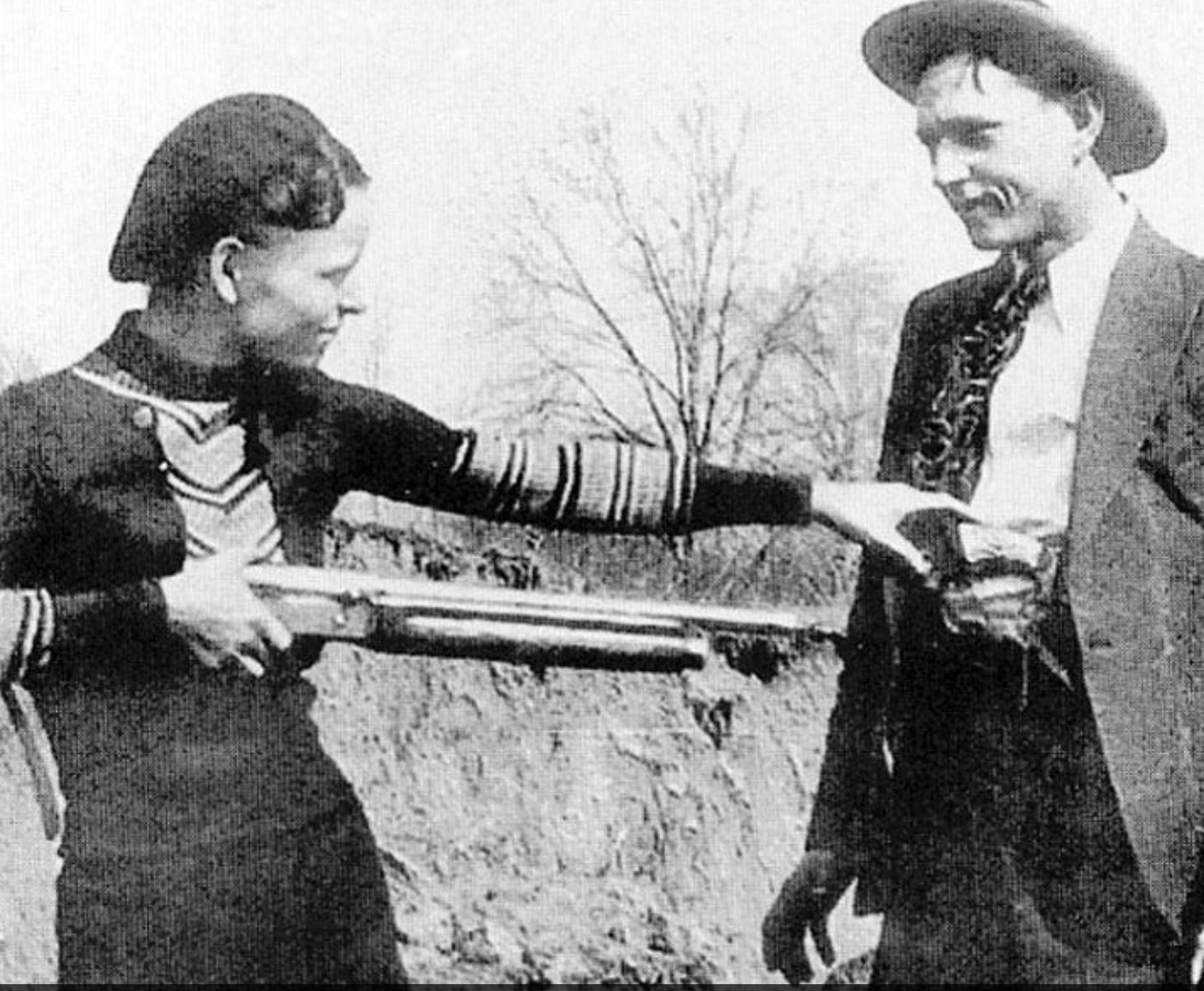
I’m standing near the spot that almost ended the criminal career of the notorious Bonnie and Clyde on June 10, 1933. The final ending for the pair would come later, but this specific spot at the top of Texas, next to the Salt Fork Red River, changed Bonnie’s life in a significant way and added a story to the area’s history that is still compelling to this day.
Bonnie and Clyde were a couple of outlaws, famous depression-era desperados in the early thirties: Bonnie Elizabeth Parker and Clyde Chestnut Barrows.
Maybe Clyde’s parents bestowing a middle name on him, like “Chestnut,” had something to do with the anger he carried inside. Okay, I’m playing armchair analyst here, but it’s a thought worth pondering.
Bonnie and Clyde centered on robbing banks, along with Clyde’s brother and their various gang members who joined up with them from time to time. Their crime spree wrecked havoc that included murder, from Texas, Oklahoma, Kansas, Louisiana, Arkansas, Missouri, to Illinois.
On a side note, as a teenager, I had the intriguing experience of interviewing one of their colleagues, Frank Hardy. He had retired to Waco, Texas after his life in crime, which included an extended stay behind bars. He died of a heart attack shortly after our interview. This is while I was in high school writing for the student newspaper. I’ll tell you about that another time.
So, back in 1933, Bonnie and Clyde were driving the same route I’m on today, but with a little more motivation. They were desperately trying to reach the Oklahoma state line to meet up with Clyde’s brother, and fleeing the Texas law. Fortunately, I am able to take my time, meandering, with no one chasing after me (as far as I know).
Bonnie and Clyde, along with a gang member, William Jones, raced to the state border on that hot June 10th day. Getting to the state line was a key strategy because law enforcement officers lost the authority to enforce their state laws if they crossed their state boundaries. Before cell phones, the internet, and sparsity of land-line telephones, communicating was not as easy as it is today, all to the benefit of the bad guys.
Reaching the Oklahoma/Texas state line for Bonnie and Clyde meant a reprieve from the immediate pursuit of the Texas police. An escape from justice, for the moment.
In the hasty flee for the border they apparently didn’t see the detour sign warning the bridge had been washed away. Bonnie and Clyde’s Ford coup plunged into a dry creek bed off the Salt Fork of the Red River.
The whole incidence, starting with the car speeding past the barriers, then plunging into the creek bed, was witnessed by a farmer, John Pritchard, and his family, from their farmhouse nearby.
John Pritchard, his dad, and brother-in-law, being good citizens rushed to the scene, helping to save Bonnie, Clyde and his brother from the burning car rolled over on its side. Not knowing the victims were criminals, the Pritchard family cared for them in their home.
Bonnie’s leg was burnt from the car fire and splashing battery acid, resulting in her being afflicted with a limp, needing assistance to walk, the rest of her life. The Clyde Barrow was nicked-up and bruised. They required medical attention, so Pritchard’s son-in-law, Alonzo Cartwright, drove into town to get a doctor.
Before the doctor arrived, the Sheriff and his deputy showed up at the farmhouse. Clyde reacted, and Bonnie suddenly came to life. They took their guns, handcuffed them, and proceeded to kidnap them in their own car. A scuffle resulted in the farmer’s daughter being shot in one hand, while in her other hand she held her baby.
To ensure the farmer couldn’t follow them, the gangsters shot out the tires of the Pritchard family automobile. Before leaving, Clyde offered money to Pritchard saying, “… for all the trouble we’ve been to you.”
“No,” said Pritchard, “if a man can’t help another man, things are in pretty bad shape.”
After crossing into Oklahoma, the gang tied the Sheriff and deputy to a tree with barbed wire near the town of Sayre.
Bonnie and Clyde would live nearly another year before being gunned down by Texas Rangers.
In the wrecked Ford coupe abandoned in the riverbed, Bonnie left one of her leather gloves. Clyde got his guns but overlooked an ammo clip, still loaded with twenty rounds of bullets.
Those two items are kept to this day at the Collingsworth County Museum in Wellington. A reminder of the day Bonnie and Clyde made a mark on the otherwise quiet little community.
Just one of the stories along the Heartland Highway. And it’s back on in ARGO for me, headed north on 83, discovering America, one story at a time.
See you down the road #JohnButlersBuzz
(Special thanks to the Collingsworth County Museum and the Texas Historical Commission.)
FLASHBACK 1968
Reflecting on a key year in American history and a high school graduating class in Texas.

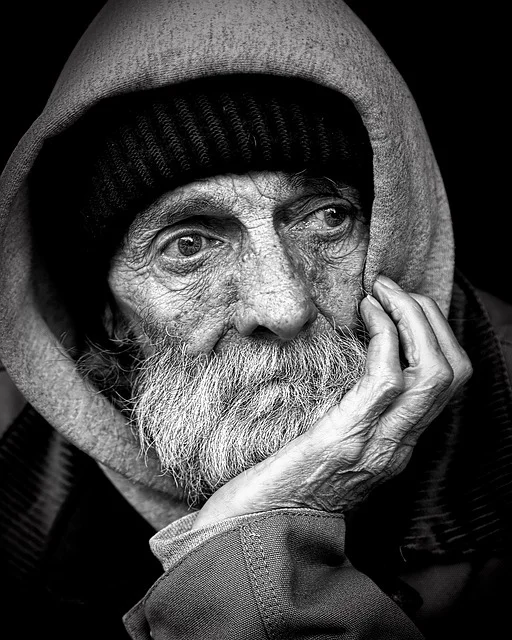
BREAD PUDDING CHRISTMAS ON A COLD DRIZZLY DAY
Modern day nomadic tribes are in nearly every American city and town I’ve traveled through this year. From Maine to California, they are at intersections holding brown cardboard signs with forlorn scribbles. They are sleeping in the doorways of buildings, under bridges. They lurk outside of stores asking for spare change. Wandering rootless vagrants. Languishing, distressed and discarded on cold dirty sidewalks. The homeless.

Modern day nomadic tribes are in nearly every American city and town I’ve traveled through this year. From Maine to California, they are at intersections holding brown cardboard signs with forlorn scribbles. They are sleeping in the doorways of buildings, under bridges. They lurk outside of stores asking for spare change. Wandering rootless vagrants. Languishing, distressed and discarded on cold dirty sidewalks. The homeless.
As I walk in a historic area of downtown Seattle, I turn the corner and end up in the midst of a scrappy assembly of street people. I look up to the sign on the brown brick building. It's the Union Gospel Mission.
I feel very uneasy. They stare at me, but I say hello to one, then another. By the front doorway is a bright-faced Irish girl. She tells me her name is Nicole. I ask her to tell me about her life.
“I’ve seen Hell,” Nicole says.
It’s almost dinner time and she is waiting to go inside for a free meal.
“I’ve seen violence … I’ve seen shootings … I’ve seen ….” She lets out a sigh and looks away as scenes of violence flash through her mind.
She sits on a box of her clothing and her other belongings on the sidewalk guarding them.
“I was raped and almost killed.” Nikole punctuates her sentences with nervous smiles. “It’s been hard.”
Her light blue eyes do not reflect the barbarity of street life, but she has seen it. “From New York to Seattle,” she tells me, “for nine years.. But Nicole still holds herself with an air of dignity. Her reddish blonde hair is brushed back, falling slightly over the left shoulder of her clean blue hooded pullover. Her new hoody and clothing were gifts from churches and social agencies.
As I talk to Nicole, I am aware of more and more people around me in front of the Union Gospel Mission. Most have a laminated badge attached to a cord around their neck. It shows they are approved for entry when the front door opens to the hot meal about to be served inside.
Whiskey fumes and cigarette smoke drift through the air from several men standing nearby. The fray of rough-looking castaways increase. I’m uncomfortable. I’ve been forewarned to be careful. Many are felons, some violent multiple offenders.
A skinny African American man sheathed in a foreboding dark aura stands next to a tall emaciated pock-marked white woman at the edge of the street curb. Both staring at me intently like bobcats. The once attractive girl has the look I’ve seen in photos showing the human ravages of advanced meth addiction.
She grins at me as she swirls in place like there is a tornado twisting inside her; repeating over and over, “I’m a bad ass … I’m a bad ass….” Her eyes are inviting me over. The man stands guard next to her, looking at me with cold black vacant eyes. A look that says he could easily kill me if I come too close.
My heart beats faster. I try to look totally at ease and unworried midst this group. I’m not.
A young African American man is watching me from down the sidewalk. He’s crouched, leaning against the brick wall near the front door wearing a pullover wool cap and a hooded fleece under an oversized heavy-weather jacket. He smiles as he is talking -- to either me or the air. I’m not sure which.
I walk over and ask him to tell me his story. His name is Troy. “I’ve been on the streets between five and seven years,” he tells me.
“There is one word that explains it all,” he says as he rambles, drawing in smoke from the nub remaining of his cigarette pinched between his fingers. He repeats a word several times, but I have difficulty understanding him. And he wants me to understand.
“It’s in the ten-million word dictionary,” he says. “It’s the only one that has the word and it costs a lot of money to get it.” Trying to grasp the word he is telling me, I ask him to spell it. His language is rough.
“Ya know what … it’s like … J … S … K … M-I-A … ah … O-M-R-Y.”
The word I think he is trying to tell me is “Jakari.” It is the only one I can find in any dictionary close to what I think he was saying. It did fit with life on the streets he was describing to me.
Jakari, as defined in the Urban dictionary: “One who is a key component in the African America culture and continuously dumps trash cans upon people’s head and body.” Jakari.
I ask him, “What’s the worst thing that has happened to you on the streets?”
“I’ve been robbed,” he says. “I’ve been shot at. I’ve been stabbed. I’ve been murdered. I just say give it to me … give it to me … know what I mean.”
I think I do. We talk more, Troy has an odd acceptance about his situation. A strange sense of peace he finds in this word he repeats: Ja-ka-ri.
“I ain’t gonna to say I’m not scared of s#@%,” he says, “but I ain’t gonna let nothin’ bother me where I can’t go do what I think I want to do when I want to do it.”
Further down the sidewalk a 46-year-old white male, wiry in build, sporting a ball cap and mustache, is watching me intently. He walks across the sidewalk, right up to me, smiling off and on. Trevor is his name. He tells me he came to Seattle from California. Heard about the place from a relative.
“I’ve been on the streets … since I was 16 … I lost four members of my family and my mom,” Trevor says.
Each person I talk to volunteered they had used drugs and all of them tell me how long they have been clean with a certainty in their voice, but lingering eye contact to see if I believe them. I was never convinced of the last part.
“I started using methamphetamines at the age of 24,” Trevor continued. “At the time it was a drug I liked … but I always told myself I had a problem.”
Nicole, Troy, and Trevor are just three of the roughly 5,000 people living on the streets in the Seattle area. Another 12,000-plus use homeless emergency and temporary shelters in various parts of King County, according to the Seattle Times.
National estimates for homeless in emergency or transitional housing during the course of a year are in the million and a half range. The number under bridges, in doorways, and elsewhere on the streets of cities across the nation is undetermined.
“New York is not half as bad as the violence we see here,” Nicole tells me with a big belly laugh. “… That’s because we are getting everybody from New York.”
Nicole is from New York. She came originally to work on a fishing boat, but she says, “I was duped … it didn’t work out … the guy didn’t even have a boat.”
“I’ve been clean almost a year and a half,” she tells me. She lives in a tent under a bridge. The Mission sold her a new zero-degree sleeping bag for only $10. She said it has saved her life. She is hoping to get into the program providing tiny houses to the homeless someday.
Throughout America and around the world homeless flock to different cities for various reasons. Rumors circulate among them about the best cities with the best accommodations and the big lure: free stuff.
Some Seattle politicians proclaim their town to be a “sanctuary city.” One of the workers told me it has sent an unintended message to the homeless in other cities. They hear from newly arrived homeless, the nickname for Seattle is “Free-attle.” I confirm this with people I talk to on the street.
“Everything is free in Seattle for the homeless,” the rumor goes. “Free-attle is the place that will take care of you.”
It’s not quite that way of course. Rumors of finding nirvana never quite live up to the imagination after you arrive. But the thought of it is enough. In this case, hundreds of homeless make their way every year, to the mecca of Free-attle in the Northwest of America.
So many come that the city and the county declared a “homelessness emergency.” But that was several years ago and not much has been done about the situation critics say.
They keep coming and a growing number stay in Seattle till they die. Overdose, suicide, and murder is not uncommon. There is even a community group dedicated to remembering the homeless people who die in the city. Seattle’s Homeless Remembrance Project members meet downtown at the city court to hold memorial services for each who pass away on the streets.
“There are a number of resources for the homeless who want help,” says one of the workers at the Union Gospel Mission. “But they have to decide they want out of the homeless lifestyle. A majority of them refuse shelter beds and help, preferring to live life on their own terms. But there is always food for them. They come to the Mission for the meals.”
Solution? Obviously the first thought that comes to mind, and I see other soft hearted people doing this all the time, is to give them a little cash. A few dollars. But the ugly truth is that doesn’t help. It usually, unfortunately, only enables another day of meth, or heroin or whatever drug is available that day.
Now I am in Salt Lake City, Utah. The population seems even larger than it was in Seattle.
“Please don’t support panhandling,” Salt Lake City posted signs say. “Turn spare change into real change. Give a hand up, not a hand out. Giving to agencies is more likely to provide hot meals, medical assistance, clothing, and substance abuse help.”
I believe the sign, but my bleeding-heart side is prodding me at this moment as I walk out of a downtown store. I am holding a boxed bread pudding I just bought in a cafe on this cold drizzly day. My eye locks onto a straggly gray-bearded old man sitting next to the curb with his back against the city light pole. A faded turquoise blanket is draped over his head and body. He stares down at the curb. Without thinking, I walk over and say, “You like bread pudding?”
He looks startled. I hand him the boxed bread pudding. “Ah … I haven’t had bread pudding in years … ah … thank you sir,” He places the box on the cement in front of him and protectively covers it with the corner of his blanket. I walk on.
I think it helped him. But I know for sure, in a stupid selfish way, it helped me.
As I count my many blessings this Christmas season, I pause to remember the less fortunate among us in America living on the streets. The verse in the Good Book is surely true, “…whatever you do unto the least of these you do unto me.”
Merry Christmas to one and all.
QUEASY KNEES AT DECEPTION PASS

Continuing my trek north in Washington towards Canada I left Whidbey Island via Deception Pass ... crossing over the Deception Pass Bridge to Fidalgo Island. The pass connects Skagit Bay with the Strait of Juan de Fuca. Kayakers get an adrenaline rush during tide changes riding the standing waves in class 2 and 3 rapid conditions. I'll take a pass ... on kayaking the pass. 😉 My knees were queasy just standing on the bridge with a low railing on the bridge walkway and cars passing just a foot or two away.

Named by George Vancouver. Double bridges were built over it by the WPA in the thirties.
JohnButlersBuzz.com 🚐 John Butler at Deception Pass
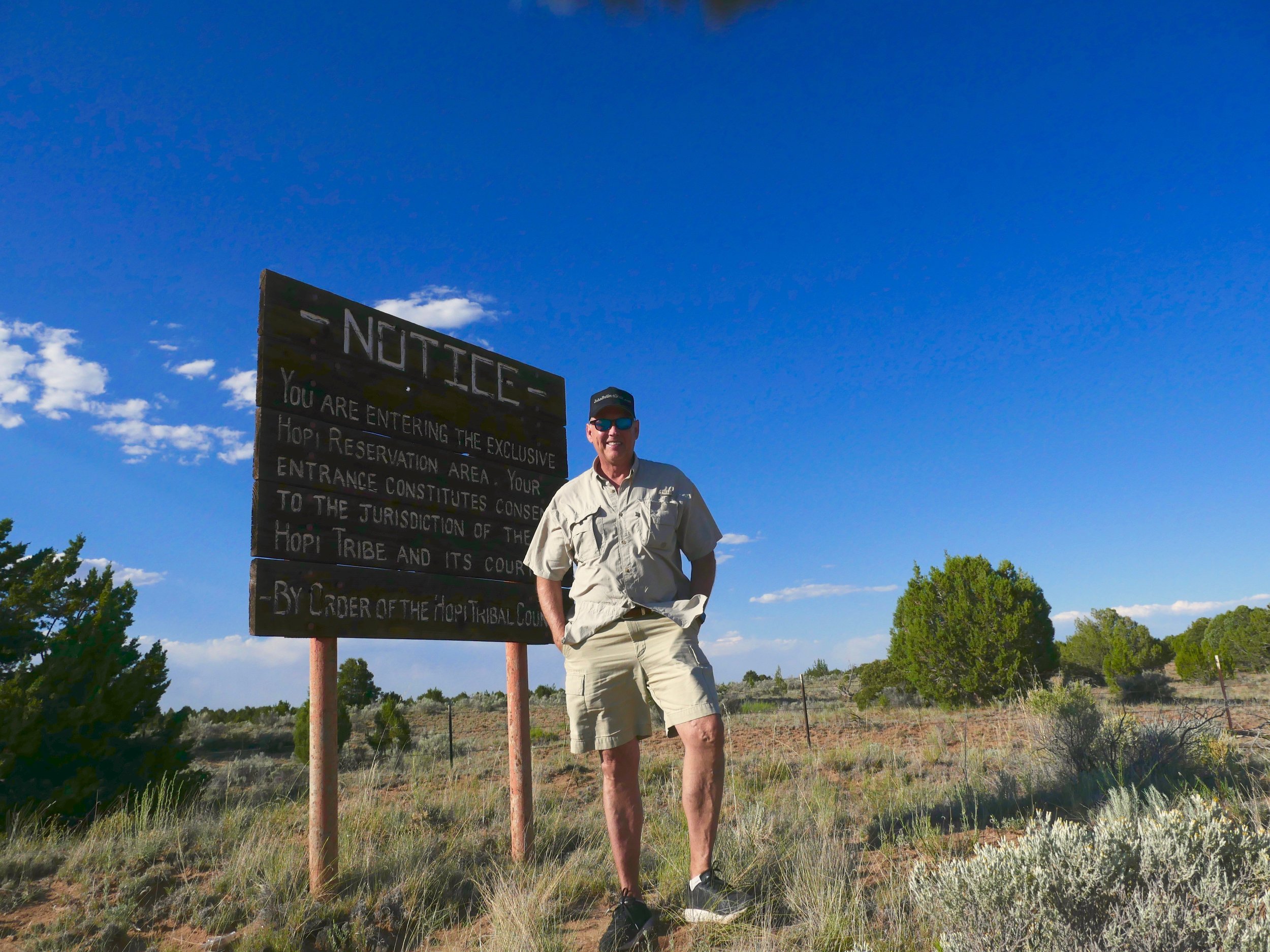
MYTHICAL & MYSTERIOUS ... 500 YEARS BC ... HOPI INDIANS IN AMERICA
Maybe it’s my imagination, Maybe I had just been staring into the direction of the sun too long driving west. But I think it was more than that. It’s hard to explain. I felt a spiritual sense about it. A shadowing, if you will, as I drove through the desert Indian territories in New Mexico and Arizona....
Maybe it’s my imagination, Maybe I had just been staring into the direction of the sun too long driving west. But I think it was more than that. It’s hard to explain. I felt a spiritual sense about it. A shadowing, if you will, as I drove through the desert Indian territories in New Mexico and Arizona.
Perhaps the spiritual perception I felt stemmed from the American Indian blood in me. It’s from my mother’s side. More about that another time.
American Indians are mythical … and mysterious. They are distinctively different, with over five-hundred tribes in North America. Organized as nations, pueblos, villages, bands and tribes. About half of the American Indian groups are in Alaska. The rest in 33 of the other states.
After leaving the Acoma Pueblo in New Mexico, I drove on to Arizona, through part of the Navajo reservation and across the Hopi tribal lands. Driving for hours over each of the reservations gave me a sense of the vastness of the Indian land in this part of America. Approximately two-percent of the United States, more than 50 million acres, is reservation land, according to the National Congress of American Indians.
The largest amount of land is held by the Navajo Nation; well over seventeen million acres. I was told by several Hopi that most ofthat was originally owned by the Hopi tribe. They are said to have arrived in North America much earlier than the Navajo. Hopi’s retain roughly two-and-a-half million acres today.
The Navajo’s are said to have a more aggressive warring history. Thus an explanation of why they occupy more land. The Hopi’s, according to what I was told by members of both tribes, are more peaceful. They have a live and let live attitude. Respect all things.
This attitude of peace is what I saw when I was around the Hopi. A spiritual approach to all things in life, with a deep respect for all forms on the earth, from the rocks to the animals. “We are all one, the earth, the animals, the rocks, the people,” I was told. We are to respect all.”
The Indian school system is quite good. English is well spoken.
Hopi Indian’s native tongue is of the Uto-Aztecan languages found in Mexico and parts of the United States. The language and traditions are still maintained by the core of the groups.
It is a struggle to hand on to those traditions. The modern world has taken many of all the tribes away from the base. Air conditioning in the desert is hard to not take advantage of, I was told by one tribe member.
But even in air conditioned houses with TV, most carry with them the traditions of their ancestors. A few maintain the primitive ways on the original lands. It is there I went to visit, to see these villages first hand. The attached video is a small part of the conversation I had with two proud Hopi members living in the oldest village.
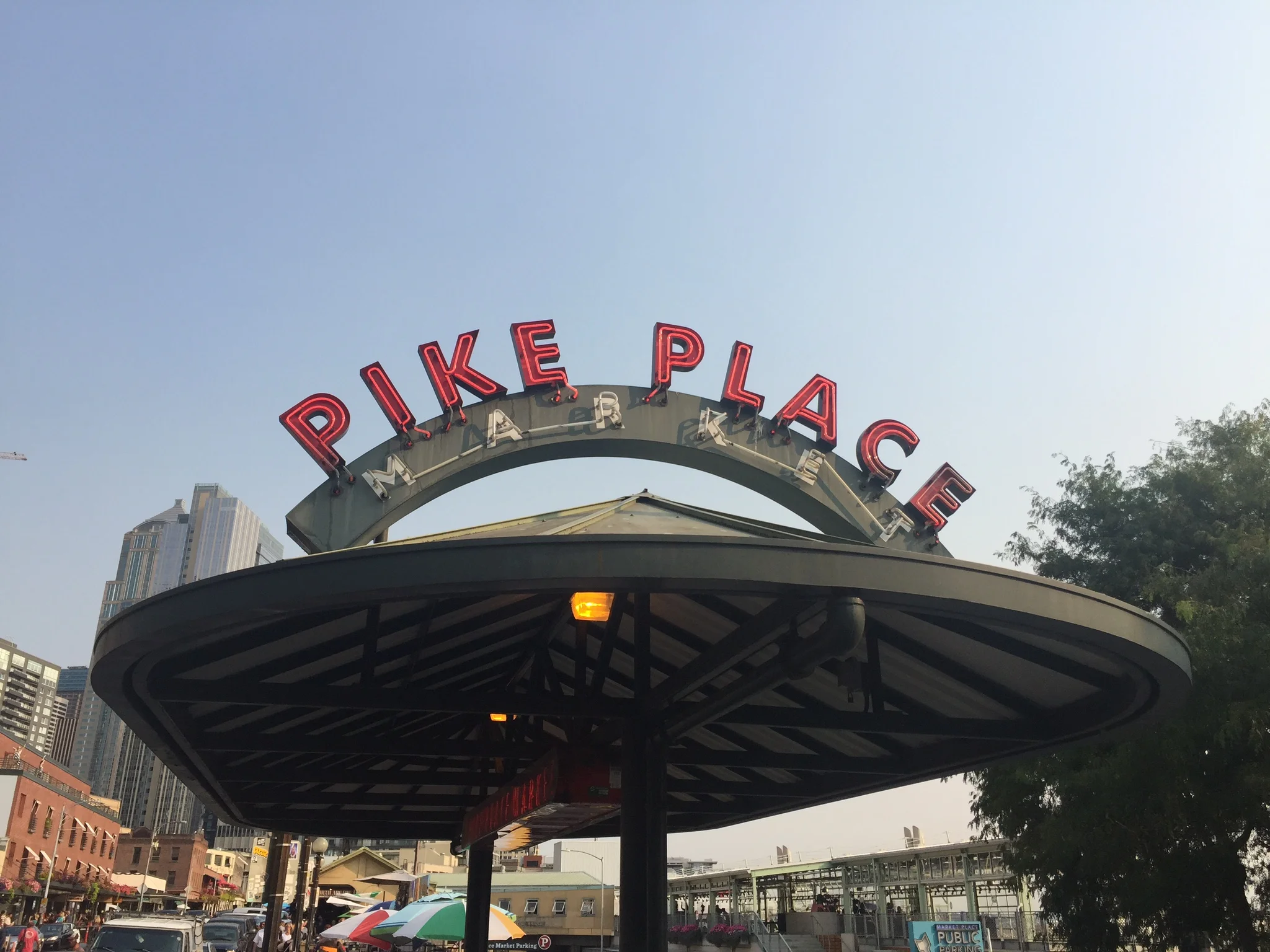
SLEEPLESS IN SEATTLE
After a few restful weeks in Oregon, I crossed into Washington state. Unfortunately, my campsites ended up being named Dismal Ditch and Cape Disappointment. I didn't name them, Lewis and Clark did.
The weird vibe didn’t hit at first, though. When the Seattle skyline came into view, a wacky ham and eggs song triggered in the back of my brain. One of those off-the-wall tunes you can’t get out of your head once it starts playing in there. You know, the one ....
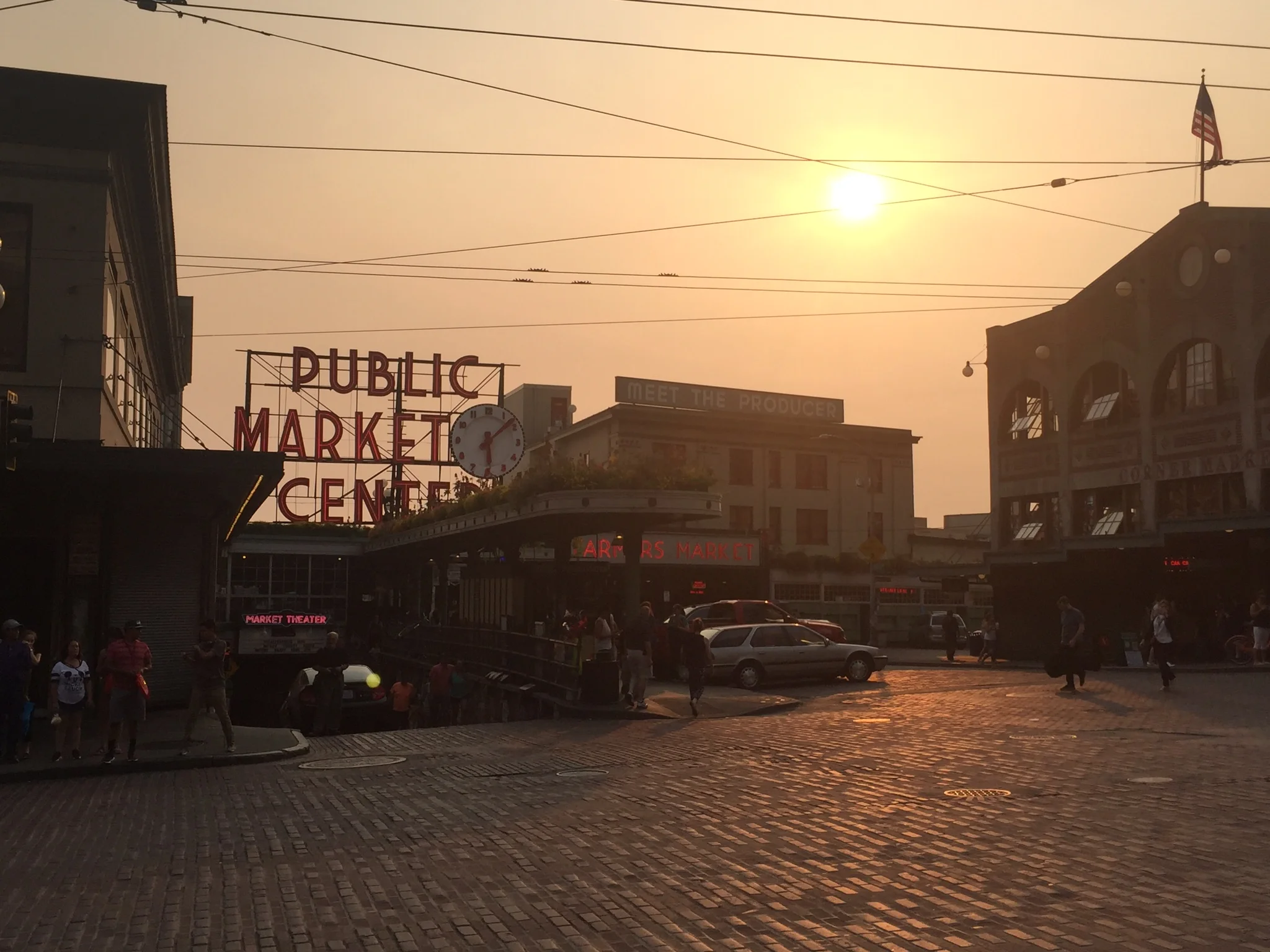
SLEEPLESS IN SEATTLE
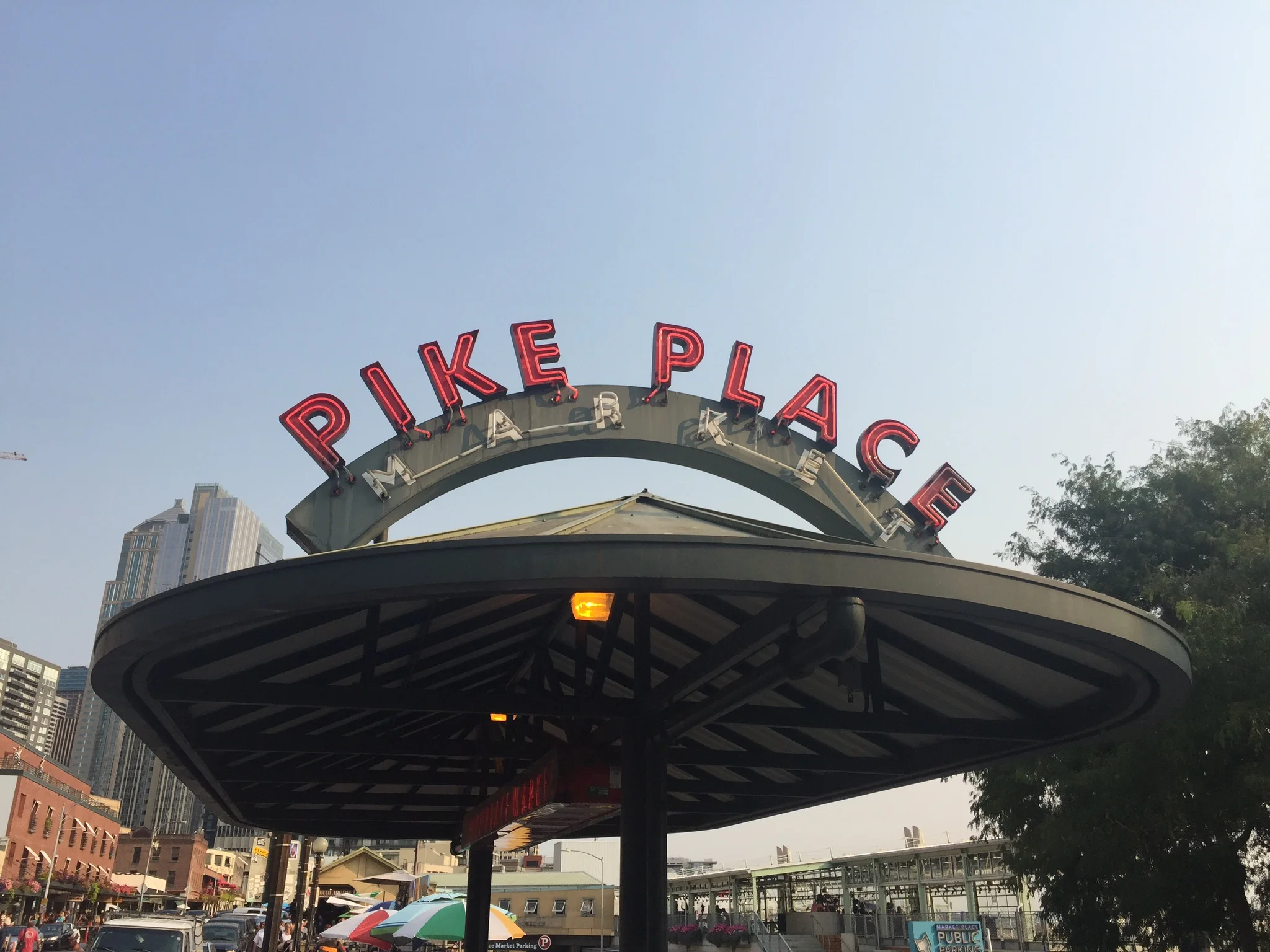
After a few restful weeks in Oregon, I crossed into Washington state. Unfortunately, my campsites ended up being named Dismal Ditch and Cape Disappointment. I didn't name them, Lewis and Clark did.
The weird vibe didn’t hit at first, though. When the Seattle skyline came into view, a wacky ham and eggs song triggered in the back of my brain. One of those off-the-wall tunes you can’t get out of your head once it starts playing in there. You know, the one from the TV show, Frasier:
“Hey, baby, I hear the blues a-callin’, tossed salad and scrambled eggs … oh my ….”
Then my GPS led me to turn on the road right next to the ominous looking Safeco Field. As I waited at the stop light next to the stadium -- also know as “The Safe” -- two guys ran right up to my passenger-side window waving white envelopes.
“Wanna buy tickets?” One was shouting at me with a big smile.
“Need tickets? I got tickets!” yelled the other one, leaning over the shoulder of the first guy.
Within seconds of arriving in the Emerald City I had a chance at buying tickets to a Mariners game. I was tempted. Sitting in the stands with a brew and a hotdog with lots of mustard, onions and relish, and maybe a little sauerkraut? I rolled down the window part way. I almost said yes. But the traffic light turned green with a line of cars behind me.
“Nice rig, buddy,” one said as I eased away to make the light.
SUNDOWN OVER PUGET SOUND
A short distance into the downtown district’s steep streets got me close to Pike Place Market. On the other side of the street was the “original” Starbucks coffee store.
I spotted a car pulling away from the curb just down the brick paved street and nabbed a perfect parking place for ARGO. (I credit these occurrences to my good “parking karma.” Can’t explain it. I just glance up humbly each time this happens to say thank you.)
I walked down to Starbucks and ordered a vente caramel macchiato to sip while I stretched my legs meandering through the Pike Place Market. The famous open-air market started in 1907. You can pick up local farmers’ seasonal produce, beautiful flowers, eccentric trinkets.
And, oh yes, you can watch the fish toss. The fresh fish being tossed across the iced bins by the cool fish wranglers started simply as a way to speed up the handling process. It evolved into a show worthy of your must-see list.
It was a rare clear day in Seattle and people were gathered to watch the sun go down over Puget Sound from the deck outback of the market. It was a spectacular sunset. You know how I love sunsets.
Next I’m standing by ARGO wondering where I am going to spend the night. There is no RV campsite remotely close to downtown Seattle.
I look up to see a sign saying parking meters only require payment between eight a.m. and eight p.m. It’s now a little past eight o’clock p.m. It occurs to me … I don’t have to move ARGO. We can stay right where we are, get a good night’s sleep, then head out in the morning before eight a.m.! It is a quiet and peaceful block. There are some homeless people on the grassy area down the street, but where I am is fine.
I prop up in ARGO to finish reading a book. The vente caramel macchiato caffeine starts to wear off. Exhausted by a full day, I fall asleep around midnight.
A LITTLE PUNCHY
At roughly two a.m. I awake.
“Stop! Stop! I didn’t do anything.” A tinny voice screams in pain just outside ARGO.
“I'm not letting you manage my money anymore!” A deep voice shouts back.
“But I didn’t take it! I just … I didn’t --.” I hear thuds. Fist-into-flesh sounds. Each followed by a yelp and crying.
“You s&%#! You b&%#@&#!” the aggressive voice yells. I’m wide awake at this point. The thought of hearing gun shots enter my mind. Stay low, I tell myself.
The pounding, crying, and scuffling goes on for some time, then fades as the fight moves down the block. Then it heads back toward ARGO. Back and forth, for what seems like an hour.
Finally, silence again. I try to go back to sleep, but never make fully make it.
GETTING OFF TRACK
The next night I’m near the ferry terminal and find another parking spot, free overnight till 8 a.m. Perfect location for being ready to board the ferry to Bainbridge Island the next day.
Except for one factor. Across the sidewalk lay two sets of train tracks.
I figured there might be a train pass by. Big deal. I like the sound of trains.
Before the night was over I would find out I was wrong about “a train” passing by during the night. I lost count. It was one an hour or more. Each time I thought, well, that has to be the last one. Not.
I could doze through some of the trains but the longer, louder steel-wheel clackers woke me up. The repetitive musicality of the wheels rolling on the iron rails a few feet from me made sleep impossible.
Then next morning, in my exhaustion I missed the ferry. I decided to stay a third night to catch up on my sleep. Another poor decision.
FEELING CLUBBED
I pulled into an office/warehouse area that was very quiet. For the moment, anyway. I fell fast asleep. At about 11 p.m. I awoke to find ARGO surrounded by people. Talking and laughing.
What was going on? I peeked out ARGO’s front window. The parking lot was crawling with young people. On the sidewalk. On the street. Uber cars and taxi cabs lined up letting people out. A sedan pulled up with a throbbing bass loud enough to vibrate my chest bone.
At the end of the block was a “pop-up” nightclub. A popular one, apparently, since the line to get in extended all the way down the block and around the corner past ARGO. There were too many people for me to even think about moving. So I endured another night of being sleepless in Seattle.
On the fourth day in Washington I made the ferry over to Bainbridge Island. Found a county park for RV and tent camping. And, minus the street fighting, train wheel clanking, and clubbers, it was sweet dreams.
SUNSET MEMORY WITH A TWIST
I hadn’t talked to anyone in several days except for the border agent who stopped me. Traveling through miles and miles of sand, cactus, and cake-bake heat had taken its toll on me. I was ready to talk. And I did.
After driving through the Arizona desert for days, I was ready for the cooler California air. Reaching San Diego I found a camping spot right on the Silver Strand State Beach, a cool and sparkling sliver of seashore between the beach towns of Imperial Beach and Coronado. The next day I called my editor, Anita Palmer, who lives in the area so we could meet up over a meal.
I hadn’t talked to anyone in several days except for the border agent who stopped me. Traveling through miles and miles of sand, cactus, and cake-bake heat had taken its toll on me. I was ready to talk. And I did.
Over dinner, Anita smiled as I spilled my guts about all I had been pondering during my desert wandering days. From weather, to the state of world affairs, to you-name-it. I may have even touched on my take on the theory of relativity at one point. I’m not kidding.
Anita got in a few words about San Diego here and there as the sun was setting. We had a brief discussion about editing. And she gave me some tips on places I might want to include on my West Coast travels. There was a pause to take in the sunset over the bay. Then I continued my unloading of pent-up desert wilderness thoughts and observations … till she was able to escape at the end of the meal. She swore she enjoyed the conversation.
Before leaving San Diego heading north for the metropolis of angels, I ventured up to a magical place, the stately veterans memorial atop Mt. Soledad. There a 22-foot white cross on top of the 822-foot suburban peak reaches toward the sky. From the memorial you can see downtown San Diego and Mexico to the south and La Jolla and the Pacific Ocean to the west and north. Quite a view for an old Texas boy.
Mt. Soledad is in the very upscale seaside community of La Jolla. Lots of rich and famous people have made La Jolla their ZIP code. For example, it was the last home of Dr. Seuss.
Some of the legends attached to this neighborhood could fit in a Dr. Seuss book. There was a folktale that Mt. Soledad was home to little people in the 1930s -- the ones who played in the Wizard of Oz movie. Tucked among its winding roads were what appeared to be tiny houses with tiny doors and windows looking west over the ocean. I would like to think it was true, but alas, it was just the angle of the hillside streets that made small homes look miniature. (Or was it?)
After walking around and taking some photos, I drove down the hill wandering the narrow streets toward the Pacific. I turned onto Coast Boulevard with homes on one side and on the other side a little stretch of beach park between the road and the ocean.
A perfect spot, I thought, for watching a sunset from one of the most western points La Jolla. Obviously I wasn’t the first to discover this perfect sunset watching spot. People were gathering already, more than an hour in advance. The limited parking spaces were all taken.
Unbelievably, just ahead, I spotted a long open parking space curbside. A space big enough for Argo. As I stepped onto the sidewalk a bit of pride washed over me for parallel parking ARGO in this spiritually provided parking space. Parking Karma ! A feeling akin to being a lottery winner. I am sure it is a similar feeling of exhilaration.
Sunset time is my favorite time of the day.
Always a reflective pause for me. A meditation moment. Something about it connects with me.
I take a photo to capture the sunset moment. Either with a camera or with my mind. Usually with both.
This night I walked across the sidewalk, over to the edge of a short cliff. A natural sand and stone path led down to the narrow beach. I walked on over to the end of the red rocks jutting out to the water. Waves were splashing up as they crashed into the side of the shoreline.
Four children were playing in the waves. Further down two people were embracing. The sun still had a good distance to go before slipping beyond the water.
As I stood there, I was debating with myself over staying the additional hour till sunset, or getting on the road to where I planned to stay the night.
The practical voice in my head said, “Hey, you can still see the sunset from the other place.” The soft wussy head voice said, “But this is too perfect of a spot to leave … and you have the prized parking space.”
Staying seemed like the “bird in the hand” best option. But it was more expedient to get to my destination before dark.
Expedience won out. I started walking back to ARGO.
I noticed a young couple that had just descended the path from the street. I stopped to let them walk pass me. Between them were a boy and a girl in the five- to eight-year-old range, I’m guessing.
The father was leaning down talking to the kids in a subdued solemn manner. The mother looked like she was in deep thought as she nodded her head in agreement.
It caught my attention. I lingered and listened as they walked on.
“It was right over here,” He pointed, looking ahead and then back at both children.
“Over here?” The little girl pointed ahead.
“Just about,” he said.
Their son loosened Mom’s handhold running forward to jump over a gap in the rocks.
“Be careful,” Mom said, reaching out to grab his hand again. The boy complied.
“Your mom and I had a blanket spread out,” Dad said. “There were candles circled around it.”
They walked on toward the where Dad had been pointing.
“This is where I proposed to your mom.” Dad paused.
Mom took the blanket out of the bag she was carrying. Dad grabbed one end to help spread it out.
It touched me. I don’t know where they traveled from to come back to this spot, this sunset. Sounded like this was the first time to bring the kids.
From wherever they traveled, this was a revered place for them. A place where a question was asked and answered. A place where two lives were changed years ago.
Now they are a family of four.
A family on their way forward, looking back to a turning point. Sharing a special memory on the spot where their new life began.
I don’t know the name of the family. We never exchanged a word. I only heard, by chance, a small portion of the account that was being shared with the son and daughter.
A sweet moment. And I rarely, if ever, use the word “sweet.” But that’s how it hit me. Their tender sweet moment touched me.
I moved back to the edge of the cliff. As I stood there watching the sun disappear, I felt the warm air of the day being pushed away with the setting of the sun. The chill of the air told me it was time to head on. I raised my camera. Took a photo. Watched the last brilliant golden flash give way to the night signaling the end of another day. I turned and walked back to ARGO.
A La Jolla sunset memory.


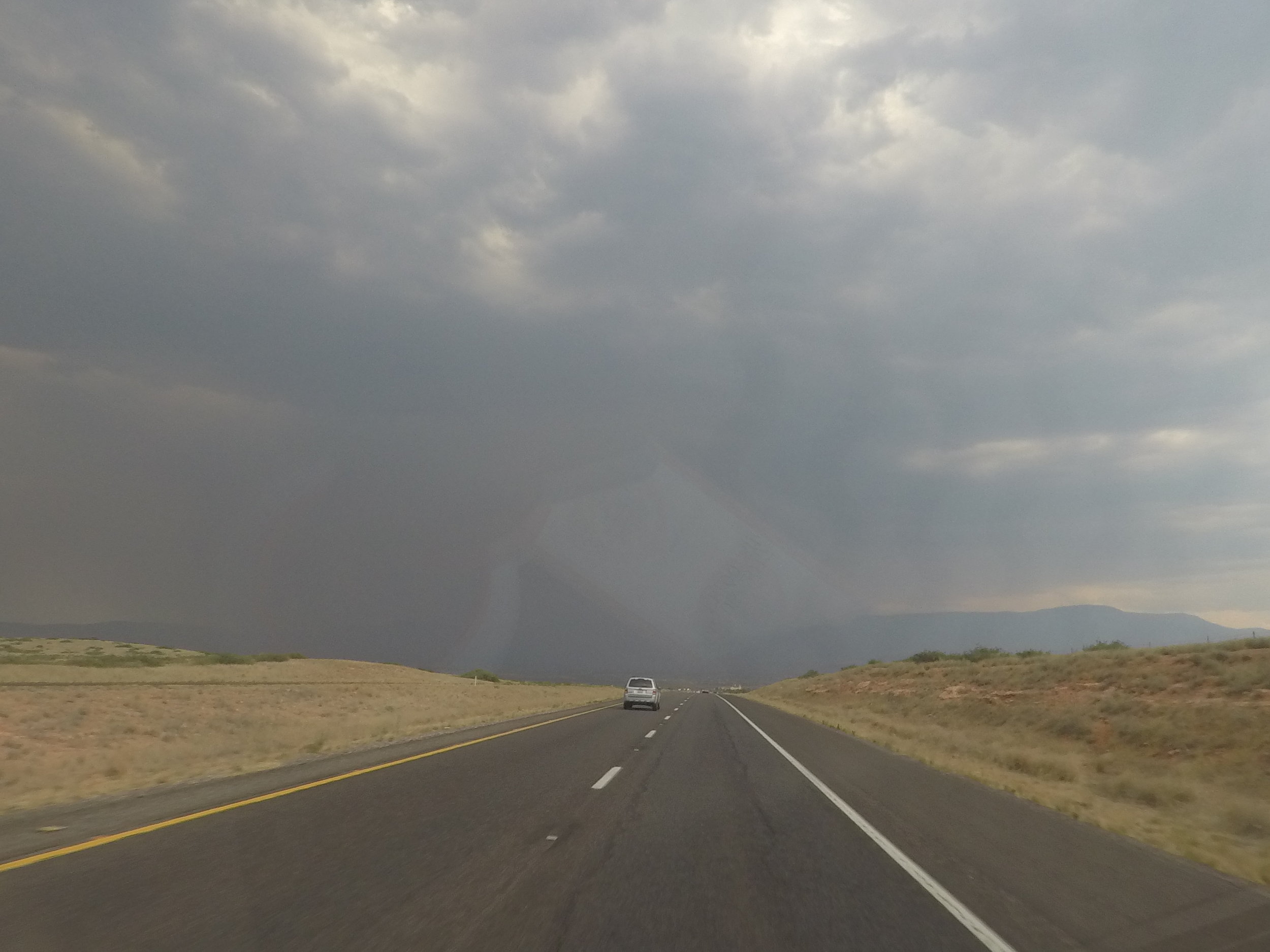
ESCAPING THE LAW ON THE DESERT BORDER
“What are you doing?” He did not have his hand on the holstered gun hanging from the right side of his belt, but the position of his cocked arm beside it made it obvious he could easily retrieve it.

I watched some dramatic sunsets in Arizona and I enjoyed the unique beauty of the vast rolling sand dunes between sporadic scrub brush-strewn desert … but the heat was getting to me. 105 degrees is hot. 114 degrees is hotter. That was the temp reached during the day. And nights were still in the triple digits most nights.
“Yeah, but it’s a dry heat,” someone not from Arizona once told me.
“Well, so is the inside of an oven,” I said. “And at 100 plus everyday, you are being baked like a cake.”
Over a few days trek I drove from Sedona to Phoenix to Yuma. Then I drove along the Mexico border.
I passed by border agents smoothing out a 20 foot or so wide path of sand running between the border and the road I was driving. They were leveling it by towing old car tires tied together behind their trucks. This smoothed the sand so they could spot foot prints.
My thoughts turned to the people attempting the crossing as I looked past that barrier over the godforsaken bleak landscape. I wondered how many people had perished, sun parched and dehydrated. Bones given over to the vultures and scavengers never to be heard of again. Walking the arid desert by day or night seems like suicide to me.
Later I was told drug runners, terrorists, and undocumented people from various parts of South America have been known to cross through this section of the border into the U.S.A illegally. They move during the night and sleep in the heat of the day. Sometimes cars are waiting to pick them up on this very road. Sometimes not.
I needed to answer the call of nature, so I stopped on the side of the road. I walked around a few minutes. It wasn’t long before a Border Patrol agent pulled his patrol car behind ARGO. An officer in a green uniform with yellow outlined patches and a gold badge approached me authoritatively.
“What are you doing?” He did not have his hand on the holstered gun hanging from the right side of his belt, but the position of his cocked arm beside it made it obvious he could easily retrieve it.
“I’m just stopping to take a break from my long drive,” I answered. “On my way to San Diego. This road will take me there, right?” I was nervously trying to assure him I was no threat.
“Yes, eventually,” he said. “This can be a dangerous road. Some people stop to pick up people crossing. It can be very unsafe.” The officer’s professional demeanor did not change.
“I understand,” I said nodding my head in deference and respectfulness. I should have kept my mouth shut, but I didn’t. “This is a stupid question … but, ah, I was expecting to see a fence or wall or something.”
“No wall,” he smiled. “A fence in parts.” He spoke firmly, but he was very polite at the same time. I was impressed with the way he handled the whole thing. We talked a minute or so more about the open desolate border. Then I felt I was pushing my luck with my questions. He gave me directions to cut up to Interstate 8 for the rest of the trip. I watched him in my rearview mirror as he watched me pull back on the road and drive off. I was on my way again, driving toward San Diego.
The heat was getting to me so it was refreshing to my eyes when finally reaching the Cleveland National Forest, traveling over the Laguna Mountain summit, and the Tecate Divide. ARGO pepped up with the cooler temps. So did I.
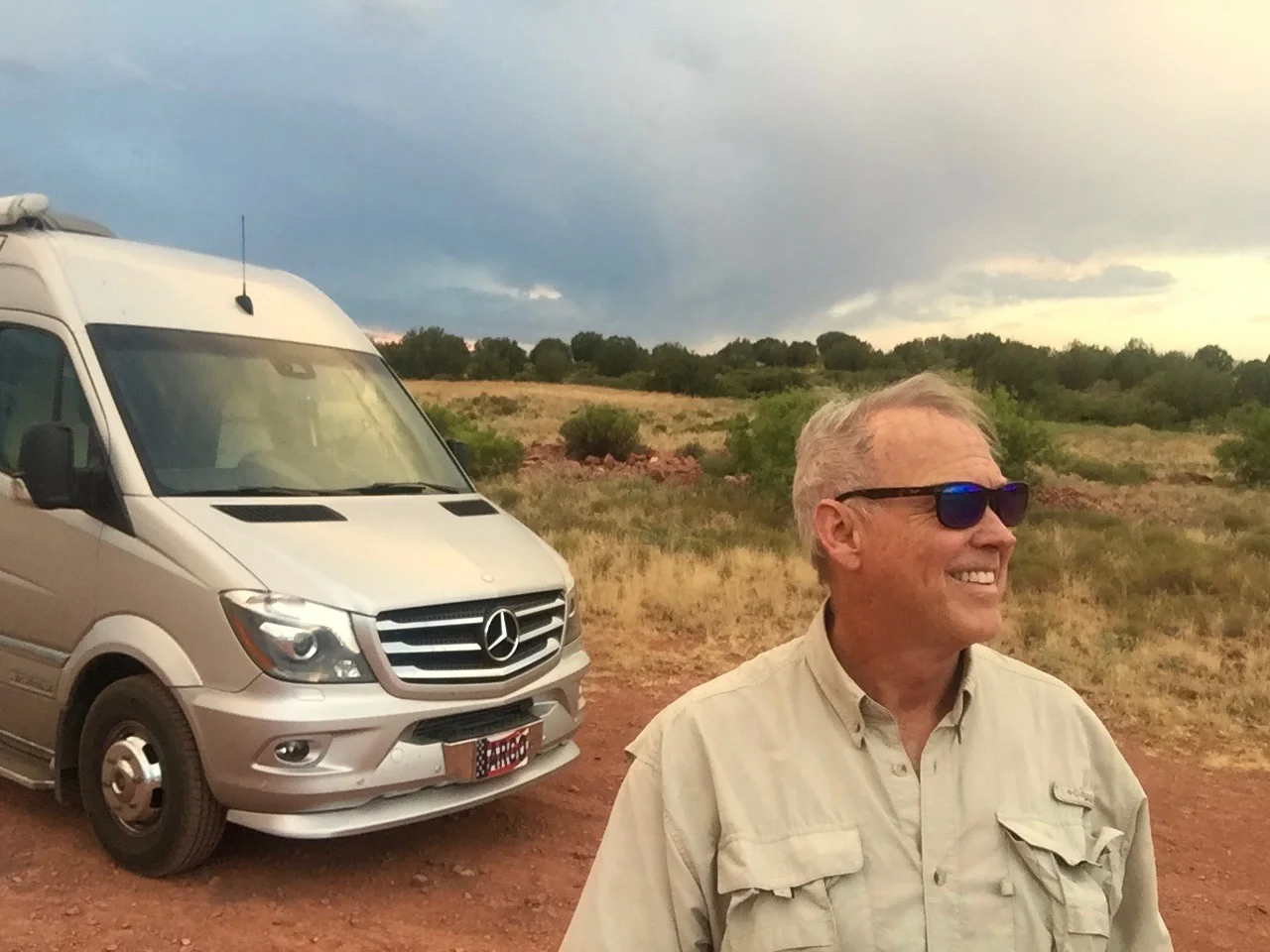
SEDONA DESERT RUDE AWAKENING ...
After my celebration of July 4th in the Grand Canyon, I started heading for old Route 66 to continue my journey west. I had wanted to drop down to Sedona after the Grand Canyon. It was even closer now. Why not, I thought.

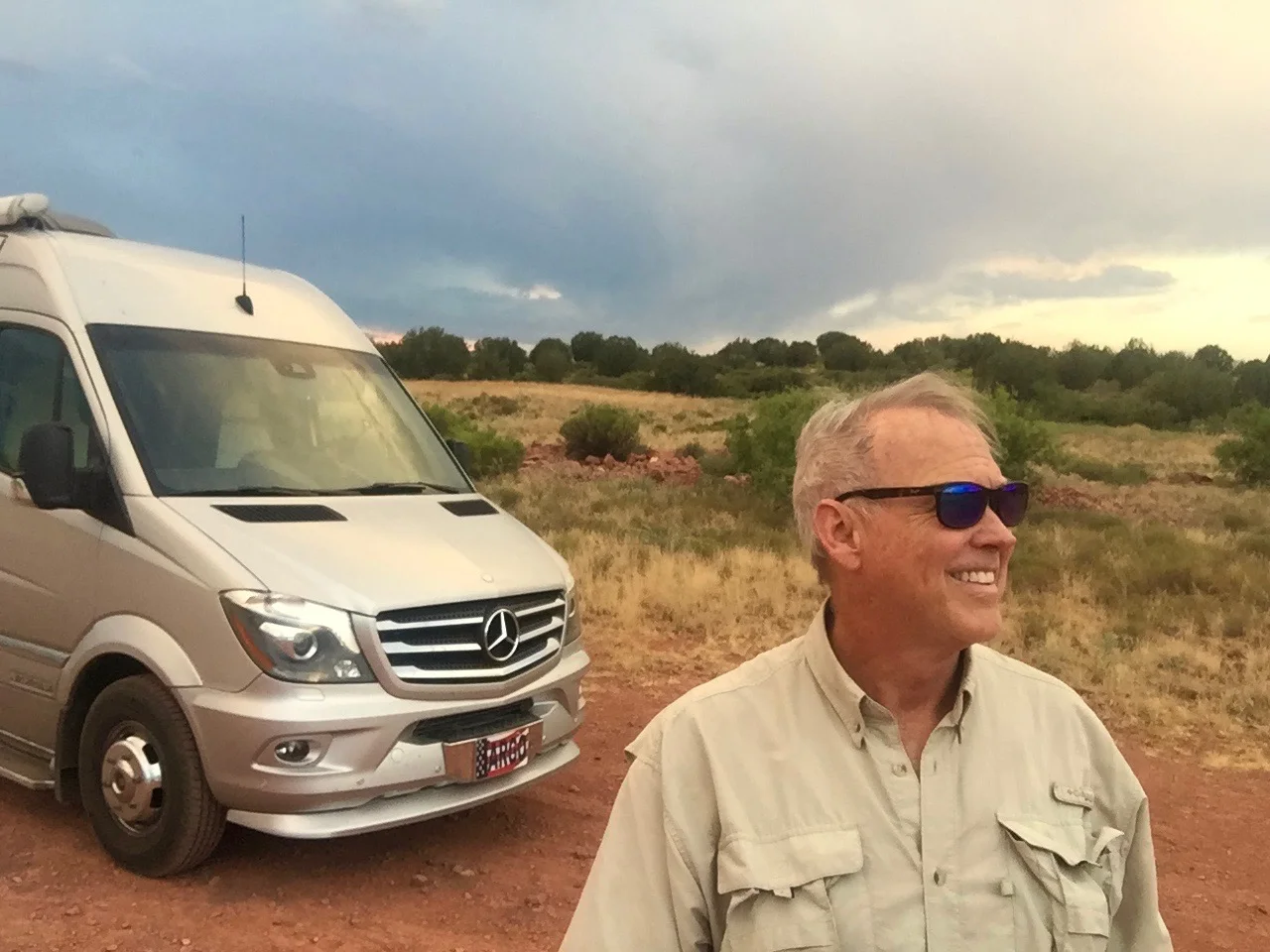
I spent the night in the Grand Canyon on July 4th. I'll post about that later, along with spending time on the Hopi, Navajo, and Acoma Pueblo Indian Reservations.
After my celebration of July 4th in the Grand Canyon, I started heading for old Route 66 to continue my journey west. I had wanted to drop down to Sedona after the Grand Canyon. It was even closer now. Why not, I thought.
So I made a U-turn pointing ARGO south to Sedona. Very glad I did as I turned on to a beautiful two-laner with tall pine trees rising up on both sides of me. Closer to Sedona the red rocks emerged into view.
The road unwound in front of me with more and more breathtaking scenery. Around each S-curve on the narrow mountain road were vistas of orange and red rock arrays rising from the earth. Bright and proud. Seemly illuminated from behind. Sandstone and limestone formations of story-book shapes and proportions. Mythical and mystical. Signs I was entering a special place.
I looked around the town for a little bit, but time was rolling by. Thought I had better pin down a place for ARGO and me for the night. That is hard to come by in Sedona. Even hotels are scarce for last-minute travelers. They’re mostly small inns accommodating New Agers.
The possibility for RV types is even rarer. But luck is always with me. At least, it has been so far.
A few spots on the map of the Coconino National Forest surrounding Sedona looked promising. About 15 minutes outside town were sites labeled "primitive" or "dispersed." A primitive campground has no fancy bathrooms or paved roads or water, and dispersed camping is the old-fashioned kind. You find a spot and set up camp.
That sounded like me. I took a chance and found a level spot to stay where a campfire had been before. Desert grass surrounded the open area around the site with rising hills on all sides. Cedar trees climbing the hill sides.
A vivid orange and multi-hued yellow and blue sunset was taking shape in the west.
It was very quiet. No one was around. No one. I stood outside ARGO. I listened. Envisioned banjo players from the movie Deliverance. Thought I could hear them beyond the hillsides.
I thought of leaving. If I stayed I would be all alone. No cell service. No one nearby to call for help. Would I be sleeping with one eye open all night?
But my adventurer side kicked in. Silence. How often do I get to experience the sounds of silence? The silence of the desert … of nature. The real world.
I stood watching the clouds above. Slowly the tranquility of the place entered me, calmed me. I absorbed the sunset.
The desert heat was less intense. I always have trouble believing how the desert cools down at night. It can drop thirty degrees from the high of the day.
The daylight slipped behind the hills. “Night cometh,” I whispered. Words some writer once penned.
The dry desert air cooled. I lay down and drifted away into the safety of my dreams. Interrupted of course a few times by the silence.
I awoke the next morning to the sound of a vehicle's tire crunching the rocky road next to my campsite. Surely not.
Popping up in bed I looked around. The sun was just rising. Enough light to see. Yes. Something was out there. Not far away, either. There behind the bushes to the northwest. A tattered fading blue pickup truck had creeped down the road past the campsite. That sound must be what woke me up. Dang. My heart raced a bit.
I searched for my binoculars. Found them in the front passenger seat of ARGO. The front windows were covered with the night shades so I went back to the rear to peer through the open window.
The truck was gone.
My heart raced a little more. My mind turned the possibilities. The crazy attacks you read about usually occur in the early morning hours. Not the dead of night.
I couldn’t see anyone outside, but I wasn’t sure. I grabbed my night stick “defender,” opened ARGO’s sliding door and walked outside to look around. Ready to defend or drive away quickly.
From over head an enormously loud roaring burst of sound: Ba- rahrrrrrrrrrrmmmm came from the sky. What the …?
Again a burst of ba-rahrrrrrrrr …. ba-rahrrrrrrr. I cocked my head upward. A balloon. A giant multi-colored hot air balloon was overhead.
The fire from its burner was blasting away. Ba-rahrrrrrrr …. ba-rahrrrrrrr.
Out of the corner of my eye I saw something race between an opening in the brush. I turned my head and focused to see what it was. I got a better look this time. A lizard chasing its breakfast.
Then from the direction of the old blue truck came another loud, but different sounding high pitched noise ripping past me. Bazzzzz-unnnn …. bazzzz-unnnnnn.
It was a scale model airplane ripping through the sky. Next to the old truck was a man holding a controller. He was putting his bright blue and yellow model airplane through some rolls and loops.
Spontaneous laughing came from my belly. I couldn’t contain it. People were playing with their model airplanes. Flying in their balloons through the sky. I was waking up in the middle of nowhere forest and I wasn’t alone. The silence of the night was broken. No one had killed me during the night. All was good.
I laughed more as I made coffee, sipped on it and through my binoculars watched the people in the balloon’s basket wave at me. I waved hardily back. It was the beginning of a new day. A loud one. A new and glorious day.
Hot air balloons over ARGO & me. - JohnButlersBuzz.com
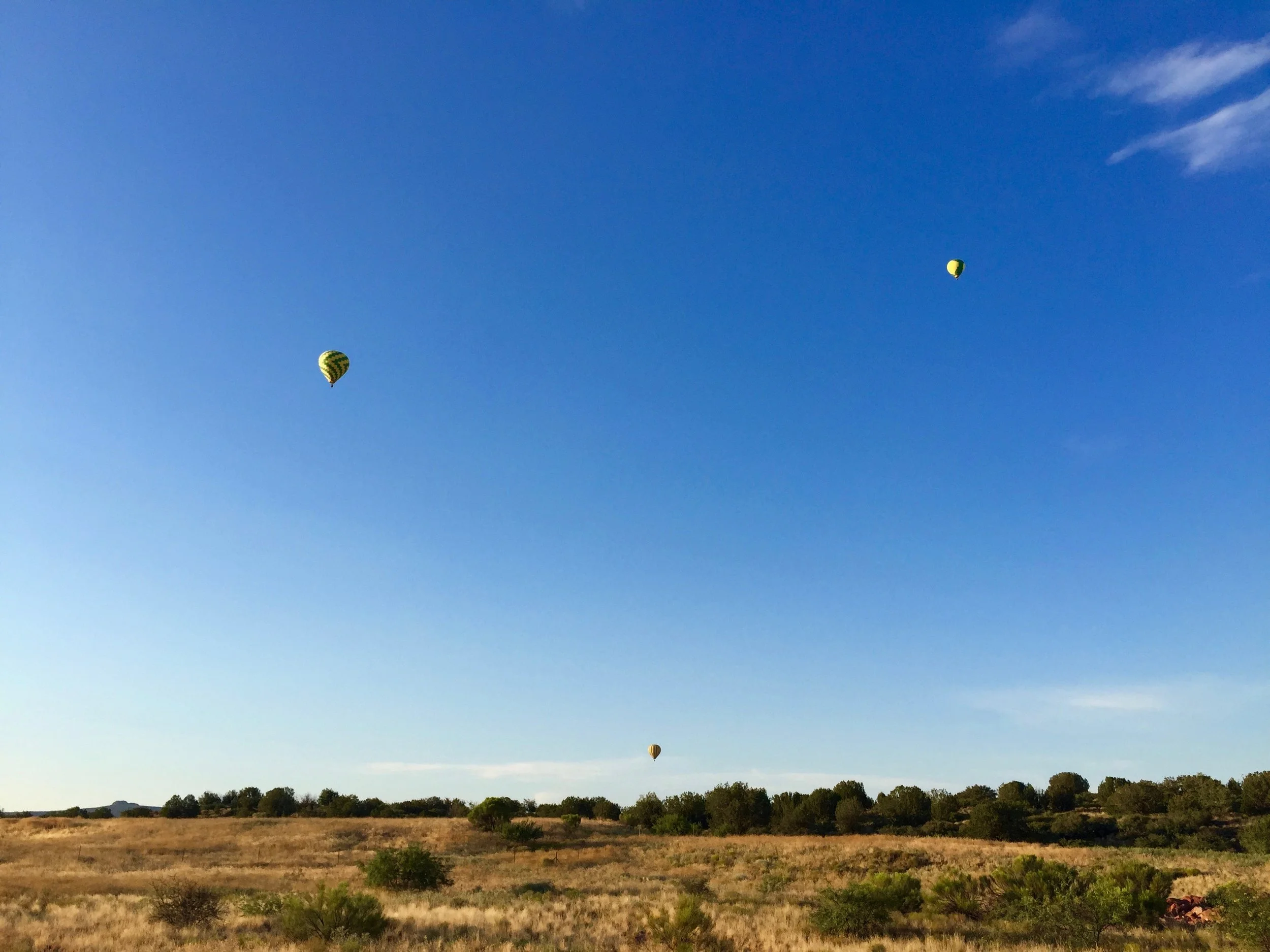
More balloons drifting over ARGO & me early in the morning. JohnButlersBuzz.com
HAD TO STOP TO LOOK - TEXAS SIZED SENSE OF HUMOR & ART
Cadillac Ranch is an art project that was funded by Stanley Marsh 3. He was known as a prankster and philanthropist in West Texas. It was created by an art group, the Ant Farm. It consists of 10 Cadillacs partially buried in the ground nose first. Each spray painted, continually, by those who visit. And visitors are encouraged to do so. It is located just off the road along I-40, by historic Route 66.
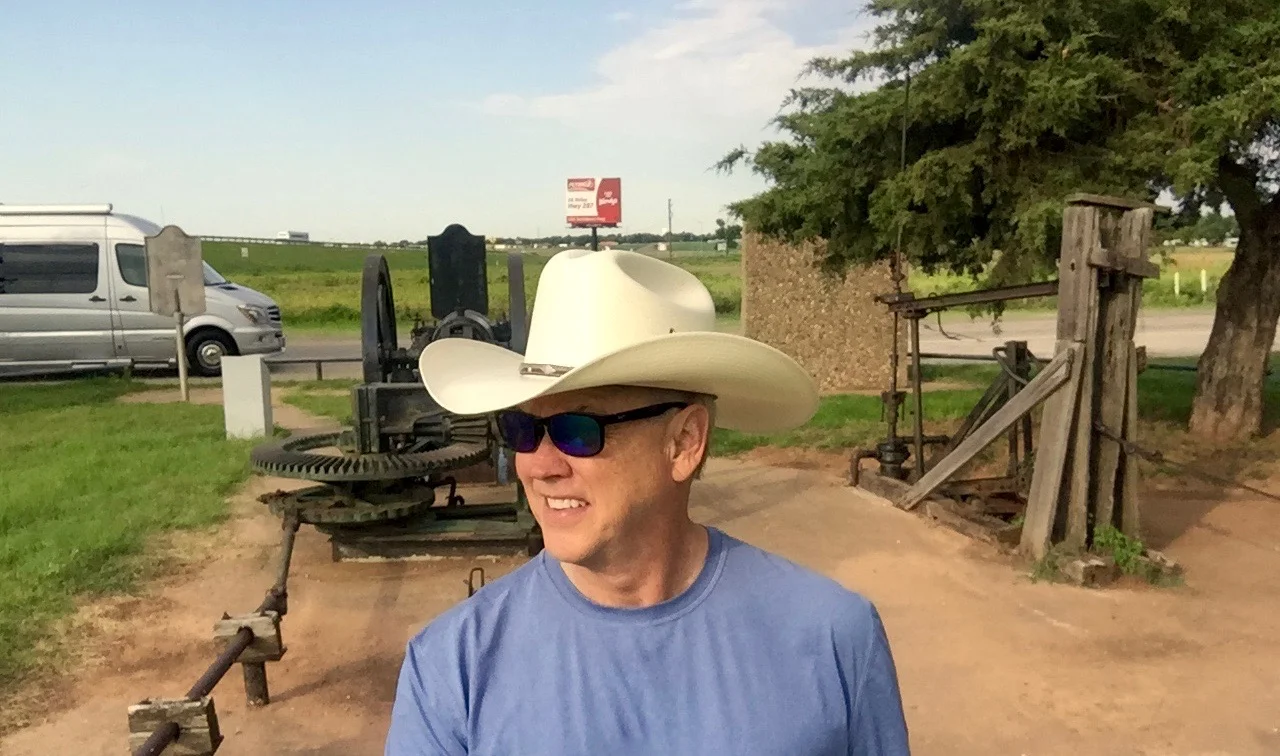
ROCKEFELLER'S SECRET SUCCESS sauce
Continuing my drive northwest from Fort Worth, I took the smaller roads, on past Wichita Falls. I headed a little further north to Burkburnett, Texas. What’s mostly there is an interesting history, Texas oil history. Oil gushed up. Money rained down. People rushed in.

Continuing my drive northwest from Fort Worth, I took the smaller road on past Wichita Falls to Burkburnett, Texas. A hole in the ground there made history back in the day.
Originally settled by ranchers around 1856 with a population barely topping 100 until 1912. That’s when someone poked a hole in the ground deeper than the wheat plants were planted. Much deeper.
Oil gushed up. Money rained down. People rushed in.
Roughly 20,000 people found Burkburnett on the map and set up tent camps around the oil fields.
I drove past two historical monument signs sticking up on metal poles along the roadside next to each other. Some iron and weathered wood contraptions lay behind the signs. Odd, I thought.
So, I turned ARGO around and went over to take a look. Turns out I was standing on a very important piece of Texas history. Important for two reasons.
The first plaque commemorated Burkburnett, Texas for being one of the more famous Texas oil boom towns. I looked left, right. Just open agricultural fields. Didn't see any boom town.
Seemingly, all that remains of the boom part of it are the plaques planted there by the State of Texas. They mark the site where, nearby, a 2200 barrel oil gusher was struck on the S.L. Fowler farm setting an oil boom in motion. Incidentally, the term, "gusher," is used because these wells were drilled before the advent of pressure control systems. When a high pressure oil reserve underground was reached with the drilling bit, it literally gushed up through the drilled hole into the air. Some times the pressure was so great the pipe would be blown right out of the ground launching it toward the clouds.
I did see later that there were still a few pumpjack's bobbing up and down next to the rusty wire fence line further up the road. After all the years, the aging iron piston pumps are still producing and earning their keep. Some old timers call those pumps nodding donkeys, thirsty birds, crickets and such. Growing up in Texas, my friends and I called them Iron head horses. Iron head horses ... bowing to the ground for the Texas Tea, then raising their heads to Heaven to give thanks.
So why should you care? Well, pause for a moment and think about it. Wherever you live in this modern world your life would be very different right now if this and other oil gushers similar to this one hadn't happened. Different on multiple levels. For starters, you wouldn't be reading this on whatever electronic device you are reading it on. I'll leave the rest to your imagination. And, it goes without saying, if those huge oil strikes had not happened in this state, Texas would be a way different place; a lot more cows and a lot less Dallas and Houston.
Behind the historical plaques lay the remains of a few well worn parts that made up the body of the first drilling rig used there. An iron and wood testament to the black gold that came forth from the earth. A testament to the people who worked the wells to capture the resulting riches. A testament to the joys and conflicts that came with the riches.
One of the resulting conflicts was a big 'un. It was between the neighboring states.
Texas and Oklahoma’s border had been the Red River since the Spanish colonial days. Didn’t much matter where the exact boundary line was located, in the middle of the river or either bank of the Red River … that is, till oil was discovered in Burkburnett.
And yes, that leads to the second main reason Burkburnett is an important part of Texas history ... and … Texas geography.
Yep, you guessed it. Burkburnett was a spit and holler from that Red River. It took the Supreme Court to decide the matter in the early 20’s. "And dang it," Texans would say, "those dang Yankees up in DC gave away part of our state when they made the south bank of the Red River the Texas border." (I used the colloquialism, "dang," in case any children or Baptist are reading this far.)
This Supreme Court decision even had an impact on sports. Well, let’s just say it helped add a little fuel to a certain college football game rivalry. The one played out each year between the Texas Longhorns and the Oklahoma Sooners. A story all by itself for another time.
By the way, Hollywood got in on the action too. A movie was made about the rip-snorter wildcatter history of the area bringing worldwide fame. It was based on a book, Lady Comes To Burkburnett, written about the goings on there during that period. The movie Boomtown, starred Spencer Tracy and Clark Gable. Movie goers got an up close and personal romanticized view of the Texas oil gusher years and Burkburnett’s role in it all.
And better yet, on the scholarly side, some historians point to this period of gigantic oil discoveries in the Lone Star State as the starting point of the "World's Oil Age. They site Burkburnett's gusher, along with the even bigger one that proceeded it, the "mother of the gushers, Spindletop, near Beaumont and, of course, the humongous East Texas discoveries that made H.L. Hunt a very happy man. And a very very rich one. These historic oil finds and others around the state got everyone's attention worldwide in one way or the other.
Finding money in the ground, like say, in the case of gold and oil, gets people thinking when they here the news. And that kind of news travels fast. (Almost as fast as bad news. Almost.)
John D. Rockefeller wasn't from Texas, he was born in upper New York state and lived in Cleveland. But he could read a newspaper. And, having been an assistant bookkeeper, he knew enough math to add and multiply.
Barrels of oilxlots of money per barrelx lots of barrels of oil = lots and lots of money
So, nearly everyone who played a role in the oil booms in someway, but businessmen watching from afar like Rockefeller reaped the big riches eventually. I mention him because he ended up controlling ninety per cent of all the oil in America at one point.
“Rockefeller once explained the secret of success. ‘Get up early, work late … and strike oil.” According to Joey Adams. Well, that's exactly what happened in Burkburnett, Texas. People got up early, worked late and struck oil.
By the way, some historians who have studied this period of oil history and Rockefeller, suggest you might add a dash of greed, or maybe a cup or two, into Rockefeller's "secret success sauce." But that's "a whole 'nuther story."
And so, it’s on down the road I go. Driving past the oil fields and the wheat fields, and through the history of it all. Heading west.
FLASHBACKS OF THE FAMILY FARM & MY DAD ....
My dad said he soon learned that on the night of the funeral, under the cover of darkness, the neighbor, who had sold the mules to my grandfather, snuck over the fence and took the mules away.
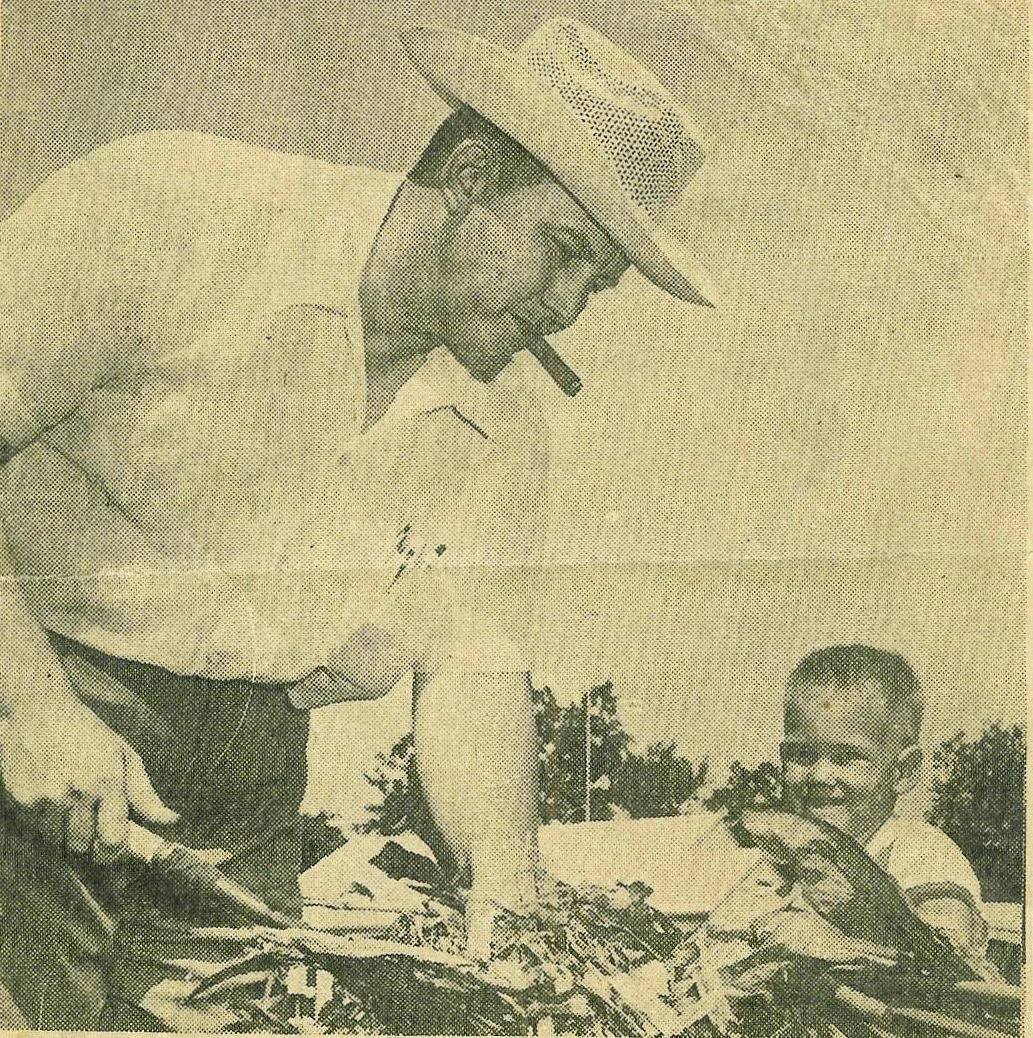
Working with my dad in the yard together. I was 4 years old when this photo was taken.
It’s not forever, but West Texas seems that way driving through. It’s a vast, often tedious, landscape.
Once you drive through the Grand Prairie and Western Cross Timbers regions west of the Dallas-Fort Worth Metroplex, you’re into the West Texas Rolling Plains with mostly sandy soil dotted by scrub oak, juniper, live oak and pinyon pine. Doesn’t change much in the High Plains of the Texas Panhandle. Same desert landscape with the addition of cottonwood, mesquite and prairie crabapple.
A New Yorker journalist once said, according to columnist Michael Barr, “I know all about West Texas. It’s the place with the most cows and the least milk, the most rivers and the least water, and where you can look the farthest and see the least.”
I left Fort Worth going northwest driving mostly on the two-laners. Soon I was passing not far from where my dad’s family farmed after moving from Mississippi to Texas in the thirties.
Stories my dad told me flashed back as I drove near the old farm; especially one. The one about the sudden death of his dad, my grandfather. He died from a respiratory illness that would be easily treated and cured today.
His death left my grandmother with five children. As I remember the story, my dad was still in his teens. He had one older and one younger sister, and two much younger brothers. As the oldest male my dad took on the responsibility of running the farm and making sure the family’s basic needs were met.
The Butler family cemetery plot was back close to their farm near Starkville, Mississippi. After a service in Ft. Worth, my dad was to accompany the body back on the train late the following day for another service graveside and burial in the family plot.
However, the morning after my grandfather’s funeral service in Fort Worth there was an unexpected and shocking surprise for the grieving family. An especial unpleasant surprise for my dad.
In those days mules were used to work the farm, plow the fields. My grandfather needed extra mules and had purchased several from a neighbor. The mules were being paid for on the agreed terms with monthly payments being made till the first harvest was sold.
Dad said he woke up early the morning after the funeral knowing he had chores to do before boarding the train for Mississippi with his dad’s coffin. The events of the funeral and the pastor’s words still turning in his thoughts. He dressed. Put on his boots. Then ambled over to the barn to feed the mules as usual. Opening the barn doors he got the shocker.
The mules were gone.
The barn was empty. He called their names. He searched the fields, but the mules were nowhere in sight.
My dad said he soon learned that on the night of the funeral, under the cover of darkness, the neighbor, who had sold the mules to my grandfather, snuck over the fence and took the mules away.
Dad said, “Faced with no way to plow without mules and do the work in the fields that needed to be done … I only had one choice.”
He found the double barrel shotgun out of his dad’s closet. Loaded it with buckshot and proceeded to the neighbor’s house.
He confronted the neighbor in front of his barn. The mules were inside. My dad said he never raised the shotgun; just held it pointed at the ground. It was a show of force.
“Why did you steal our mules?” My dad asked him in as calm a voice as he could muster.
“You five kids and your ma,” the neighbor replied, “won’t be able to keep up that big farm and make payments on them mules with your dad gone,”
“Mister …,” my dad said he stated sternly while trying to control the anger he felt inside over the callousness of the neighbor, “we haven’t missed any payments! Every payment due has been paid in full … each month … none late. Not one payment has ever been missed … has it?”
“No, not yet,” the neighbor admitted.
“Then, like I said, you stole my mules,”
My dad said he felt like he was suddenly filled with authority beyond his years. The presence of the shotgun in-hand, by his side, also helped, he told me.
“Now, I’m going to take my mules back to our farm so I can finish plowing. If we miss a payment you can come get them. But we won’t.”
It was a difficult time over the coming months, but no payments were missed. And the mules were paid for in-full just a day after the first crops were harvested and sold. My dad was very proud of that.
I continued driving on, passing through the little town of Decatur, not far from where I, in my youth, spent parts of my summers on my Aunt Dolly and Uncle Irving’s farm.
It’s where I learned to help around the farm, shoot a .22 rifle, watch out for rattlesnakes, fish and, well, just be a boy. A boy growing up in Texas.
It was an important part of my education. My dad had long left the farming and ranching life after he helped move the family to an easier life in nearby Haltom City, adjacent to the bustling "Cowtown," Fort Worth. That’s where he met my mom.
But he always maintained his love and connection to the land. He passed that along to me and my sister Cathy. He gave us a deep appreciation for the beauty of each of the seasons and the earth’s cycle of life. A respect for the birth and aging cycle of plants, animals and people.
My dad taught me a lot as we worked together in the yard of our home. He usually smoked a cigar while we worked.
Mowing, planting and tending. We would use some of the same tools he used on the farm. Same ones. Even the same wheel borrow with a forged iron wheel. These things reminded him where he came from. His roots.
For as long as I can remember, a weathered mules collar and harness hung in the back corner of the tool shed of the garage.
My dad showed me how to wield the long wooden arms of the old post hole digger to plant a tree. How to use the heavy iron bar to break up rocks as we dug deeper. Each year we planted a tree.
I had the satisfaction at the end of each of those days knowing I had put in a hard days work under the hot Texas sun with my dad. It was a gift.
"When you teach your son, you teach your son's son." -The Talmud
"When a father gives to his son, both laugh; when a son gives to his father, both cry." -William Shakespeare
With sons and fathers, there's an inexplicable connection and imprint that your father leaves on you. - Brad Pitt
DISCOVERING AMERICA ONE STORY AT A TIME — THE ULTIMATE ROAD TRIP
Sometimes the journey you planned isn’t the journey you needed—and that’s where the magic begins. The detours uncover the secrets.
When award-winning author and radio/TV personality John W. Butler set out on a drive across America, he thought he was chasing the country he remembered. Instead, he found people, places, and stories that changed the way he saw everything—including himself.
Heartland Highways: In Search of America is a beautifully told road-trip memoir filled with backroads wisdom, small-town surprises, and the kind of unexpected moments that remind you life still has chapters left to write.
Whether you’re dreaming of your next adventure, starting a new season of life, or simply craving a story that makes you want to pack a bag—this is the road trip you’ll feel in your soul.
—————-
It is a journey I could only do alone. My transportation is ARGO, an Airstream Interstate Extended motor coach. I named it ARGO after the first steamship to intentionally circumnavigate the earth. Fitting I thought since I am circumnavigating America. ARGO allows me the freedom to meander the smaller blue roads and explore off the beaten paths.
So, that is what the Buzz is about, a journey of discovery. It would almost cost me my life at one point, but that's a story for later,
I invite you to come along with me.
Follow as I chronicle the people, places, history and culture in America today.